Showing posts with label review. Show all posts

Monday, April 10, 2017

Mark Knights Review of Elthos

Following is the verbatim text of Mark Knight's Review of the Elthos RPG Mythos Machine. I am posting it here to preserve a copy in case the original is blown away by any sort of internet treachery in the future...  Without further ado... Mark Knights' Review (published in Sept 2015):


I replied to a post a few months ago now saying that I would love to help out beta testing a game that was unusual. It is a universal RPG but had a piece of software that had been developed with it that would help the GM and players by enhancing the game innately. The Beta was a demanding schedule, I started late and soon realised that there was no chance, with my schedule, to keep up with the needs of the Beta. The author (of the game and software – Mark Abrams) was also seeing this across many of the participants and so changed his tack on the beta and opened it up to an open Beta test so that he can get many testers, who will find those bugs at their own pace and the updates can go ahead. The game is Elthos Role Playing Game and the Software is known as the Elthos Mythos Machine.

Elthos RPG
The entire thing is in open Beta and as such you can sign on and register and grab a copy of the rules. I would suggest that you do this in an effort to help Mark Abrams thoroughly test the Mythos Machine – but more on that later. The current rule set is available for download once you register and log in at the portal for the game and software. The rules started at version one and quickly escalated to version 8 which is where it currently stands.

Elthos is designed to be a Universal RPG that the GM uses to apply to his own worlds. As an example the book takes a fantasy styled look throughout so that flavour can be added to the text and examples making them a little more interesting. There are also sketches of the world that is presented which are wonderful in breaking up the text as it is not really a standard fantasy setting. Creatures riding dragon flies and the like make it really nice evocative art in a sketched style and I really liked the intrusions it made on my reading.

The system uses a One Die System (ODS), that is a D6 system. Any resolution, as a standard rule, has you rolling a d6 against a target number determined by the task resolution table. For example, if I were to try and poke you in the eye, the Task Resolution Table looks at my “Poke in the Eye ” skill and your “Defence Skill” and gives a number that I need to roll on one die. It may also tell me that I am too good in the art of poking in the eye and automatically hit, or you are too good at defence and I don’t even have a chance. It is a simple mechanic and worked well here. This is an extensive discussion about it in the rule book that shows the depth that the author has gone to in considering it.

But of course the author knows that there are people out there that like rolling dice and so he has also opted to implement other systems that can be used as alternates from 2 to 4 dice resolution tables. This is a nice touch, but not entirely needed, although I am sure there are people out there that will make use of it. In reality the ODS has the same effect as multiplying the dice out and is the simplest option. That is one of the funny things about RPG’s though, the simplest is often not the option that gets chosen.

Some of the reading in this book is hard going. Dense text that are trying to explain and justify the use of the rules often left me having to reread a passage or two and on one occasion asking Mark what it actually meant. This is a minor criticism though as this problem does not often materialise while you read, just every now and again.

The entire book is an example of how this system can be used, the real value is the system itself. It talks about building a character and then gives the classes (it is a class based system) that any standard fantasy setting would give. Now, when I review a Universal system I always have a setting in my head that I ask myself “Can it do that?” Now in the case of this book that looks at traditional fantasy it would not fit but the discussion is always talking about how this is an example and how you can do the creation yourself and I can clearly see a way of me doing a post-apocalyptic sci-fi western that I was thinking of as I read it. It would take some work on my part, but if you are not prepared to do work you are probably not looking at a Universal system as a GM.

Also, throughout the text Mark keeps reminding that there is the Mythos Machine available to us on the web that will help us build and flavour the entire game. There are very few situations where this prompt is not mentioned. The Mythos Machine will solve our concerns and worries. So let us now turn our eye to the…

Mythos Machine
Normally when I do a review of an RPG or a piece of software I do one or the other. This is the exciting part of Elthos. It has an entire game support/campaign support system built right alongside it. It is rare these days to find this occurring. It is normally a third party creating an app that fits a system or a generic app that fits multiple systems. The truth about the Mythos Machine is that it fits seamlessly with the Elthos RPG. If you want to play the setting that is in the book itself there is very little to do. If you want to create your own world there is a little more to do but it is really made wondorously easy by this bit of software. And just between you and I, if you wanted to use the Mythos Machine to record a campaign that did not use Elthos as the base system, it would work.

Logging into the Mythos Machine I did not know what to expect. The website is dated in appearance and the system prompts look fairly basic at the start. I followed along several of the tutorial videos that Mark has done and loaded to YouTube. He has a beautiful skill based system ordered at the bottom of your main login page to see where you are up to in your videos and what you should watch before you get to x skill. These videos are well done and in the case of several of them they have been updated during the Beta.

There are two modes to the Mythos Machine, one as a player and one as the GM. I logged in as a player to start with and made a character. The system worked OK but the interface was a little clunky. Not having people to play a game with had me a little behind the Eight ball but I could see this was a useful tool as a player. Interacting with information from the world and recording the character, not to mention managing any formula that are required is a great thing for a player.

But the magic in this system is not in the player controls. The brilliance of this system comes when you nip over to become a GM and the entire Universe of possibilities are offered up to you to play with. That may sound like a stretch, and it probably is, but the modular system that has been built into the Mythos Machine to create your world and campaign is utterly breathtaking. Mark has truly thought through every portion of this and has shown a level of understanding about what GM’s play with (or want to play with) and intuitively added them.

The interface is still a little on the clunky side but this tends to be the truth of all database systems. I started playing about with this interface to make my post apocalyptic sci-fi western and I had to catch myself. I was having way too much fun and I was going down the rabbit hole of building a campaign that I loved and would never play. I called it Captivity and first I played with the base rules system changing it so the players only got on roll of their stats. I added up the world and then I went into skills and did some modification and then I was headed to armor when I realised that I was about to chew up a massive part of my life customising this system.

Look at all the configurable goodness, I am in love…

I can only say with the utmost confidence that this is a brilliant and easy to modify tool that does everything and more that the Elthos RPG says it can do. It allows you to play with practically everything at a granular level. You can map out complete campaign arcs, one off adventures, characters, NPC’s, the magic system or psionics or whatever you want to do. It allows you to quickly and easily build classes and introduce them and it all flows so seamlessly with each other.

I am a programmer, with a big degree to show it and I am stunned at the amount of work that is laying in this application. It will be a tool that inventive GM’s will quickly learn and love using but the true beauty of it may not be apparent to everyone. This is a shame because I have seen some apps created by teams of people in the past that are just nowhere as elegant as this system.

In Conclusion

This game and system are in Beta testing phase. It is an open Beta too so I think that if you can, join up. Help Mark refine this system to the best it can be. If you can keep him informed of what works well and what is a little clunky in the rules as well as the system then this game has a very bright future.

For me, as it stands at the moment Elthos the RPG is a nice little system that is well thought out and obviously a work that the author has thoroughly thought out and it is a labour of love. He discusses it being a little based in the 70’s and 80’s games but I really feel that it has a level of originality in it. For me it is a good system and a very workable system but with the way the book is written it may put off people who do not know where to start in running their own desired game setting. It possibly could also do with a dedicated GM section too.

The real winner here is the Mythos Machine. I can literally not think of a system that works so seamlessly together. It still needs a bit of work on interface and usability but it is so powerful that I am saying you should sign up to the Beta right now just for this! All the things you wonder how you will do works brilliantly through this application and allows you a marvelous amount of power in building your own game worlds. Get to www.elthos.com, download the rules and log on to the Mythos Machine – you will not regret it!


Many thanks to Mark Knight for this absolutely lovely review!

Sunday, October 03, 2010

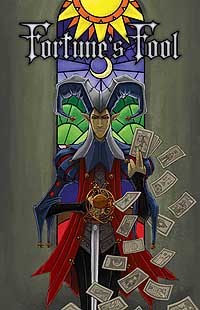
Review: Pantheon Press' Fortune's Fool

Ok, well this is not so much a Review, actually, as much as my recollections and impression of Fortune's Fool, based on my brief and engaging encounter with the Game Designer, Jay Stratton, and the Editor-In-Chief at Pantheon Press, Jason Keeley, over at the Complete Strategist in NYC on October 2nd. I have not, I should say up front, reviewed the rules in any sense of the word. However, I did sit in on a short session where the rules were basically demonstrated, and so I got the gist of things. I am going to simply convey my impressions, such as they are, in the hopes that it may help people to at least get a basic idea of the game and it's virtues and vices.

So to set the scene, I showed up late to the basement game-room of the Complete Strategist, where I found a large crowd of gamers gaming away. There was one table at the front set up for a demonstration of Fortune's Fool, and there I found the elfish and animated Gamesmaster / Game Designer, Jay, regaling the group around his table with the tale end of their game session. Apparently, things had not gone so well, and the ending was a sad affair. Poor Pinocchio! But more on that in a bit. The group seems quite happy with the game, and broke up, and so I introduced myself and took a seat. Jay and Jason were kind enough to give me an overview of how the game works.

Basically, Fortune's Fool uses a Tarot Deck for Conflict Resolution. The rules book looks very handsome, and comes to about 250 pages. I took a brief gander at the rules, and they seem quite easy to pick up. I asked Jason what inspired the idea for the game and he explained that he's always been fascinated by the Tarot, and so he decided to create a game that uses it as it's primary conflict resolution mechanism, and after two years or so of trials and travails came up with the present system, and that the game has finally pleased him. There are some interesting aspects to the game in addition to the Tarot Deck mechanics and those have to do with the coloring of the world with such things as Languages such as Latin and Hebrew which have particular magical effectiveness in the world setting. The setting is Renaissance period, and has something of a fairytale, or story-book atmosphere, though that is partially due to the particular scenarios that were selected for the demonstration. I would imagine that enterprising GMs willing to fiddle and fudge with the rules could derive quite a variety of setting-genres from the basic concept of the mechanics. The website describes the setting as follows:

"Fortune’s Fool is set in a rich and flexible time period called the ‘Fantasy Renaissance.’ This time period is rife with story lines and themes for your group to mine. The Renaissance is the time of man, but many other races flourish during this new age. Your character might be an Orc from the Russian Steppes or a sturdy Bavarian dwarf. You might play a wooden-shoed Halfling from the cobbled streets of Holland. You might even pick an ancient and immortal Elf straight from the courts of France."
The mechanics are pretty simple. You draw from the Tarot Deck whenever you resolve any kind of conflict. Your character has attributes that relate to the deck in a simple, yet effective manner. For example, when building your character you get to select which Major Arcana are favorable (I think - I was not quite 100% clear on how this part works as we were rushing along a bit), and when you draw those cards they give you bonuses of various sorts. There is a charming set of Fate Twists, such as "The House of Misery", "Fool's Errand", and "Premonition" (among many) which allow you to take certain kinds of actions with the cards to influence your chances of success. The rules are reasonably tightly tied to the genre, and while in many cases that is a limitation, in this case I think it works to the game's advantage. Just reading the book is fun, or the bits of it I've had time to read so far.

Then, as these things were being explained, another interested person showed up, and then a third. We had enough people to play a quick and dirty game, but not a lot of time to play it in. So we just jumped in feet first and gave it a whirl. Without getting much into the mechanical details I think it might help to hear the story as it was played, so I'll give a brief outline.

I played Geppetto, Pinocchio's father, and with me were Turchina a fey-like blue skinned young lady with magical powers, and my Geppetto's faithful assistant Figaro. We were together at the toy shop making preparations for Pinnocchio's 7th birthday. Geppetto was reflecting on the wonders of the boy puppet... and the sinister deal with Olga the witch he had to make in order to bring life into the wooden creation. For seven years Pinnocchio would be a normal boy, but then the spirit that animated him might rebel, and who knows what might happen then. She didn't know. Neither did Geppetto.

After a while it became apparent that Pinnocchio was not coming home. We sent Figaro to the market to see what became of the boy, since he should only have been gone for a half hour or so. Figaro came rushing back with news that Pinncchio was seen being taken away by a rival puppet-master named Mangiafuoco, the owner and director the The Grand Marionette Theatre, a gluttonous, mountain of a human. Horrified, Geppetto, Turchina, and Figaro hitched their wagon and made a mad dash to the next town to follow after Mangiafuoco. We almost fell off the edge of the cliffs along the way, but with the luck of the Tarot we managed to hold course, and only Turchina lost her horse. We made it to the town where Mangiafuoco's theater was located, and obtained enough information to form a plan. It seemed that he was advertising for a special show in which he was going to present a rare and astounding sight: A giant puppet-boy. Hmmm... Since things were dire, Geppetto explained to his friends the sinister truth regarding what exactly was lurking inside Pinnocchio. (*note: I don't think I should give too much away about the scenario for those who might play it.) We sent Figaro to apply for a job at Mangiafuoco's theater, and again with the luck of the cards he made his way in, and we got some idea of the layout of the theater, and determined how Pinnocchio would be presented on stage. Geppetto meanwhile bought three balcony seats with a view of the stage above. He hired a body guard to stand at the door. When the time came and the horribly deformed and giant Pinnocchio appeared on stage, Turchina integrated herself into the performance with a special Latin Prayer... Once more the luck of the cards was with us, and with a pretty good bit of teamwork and the careful use of the Fate Twists we maximized our odds, and won the day. Pinnochio was saved, Mangiafuoco was quelled by Geppetto's oratory (he being Pinnocchio's father, after all) and so he offered Pinnochio a job as his new Star, and so it was that Pinnocchio had a wonderful birthday after all, and secured a promising future for himself, Geppetto, and Figaro. Turchina, after gracing us with her presence and powers, vanished off to her next adventure.

All in all, it was quite fun! The only downside to the system that I could see was that it requires searching through the deck to find cards at certain points so that they can be placed in accordance with the particular ruling. That does not take long, but in the heat of battle you have sudden suspenseful gaps... which may not be the worst thing in the world.

I give the game high marks for it's excellent use of period flavor, and it's rather charming aspect. It was fast and fun, and in the right hands I think it can make for some very good RPG experiences. It did for us. The adventure of Pinnochio (of which we only played the last scene due to time constraints) can be downloaded from Pantheon Press in PDF form. It was a well designed scenario, and gives enough of an example for GMs to get the idea and follow suit with their own scenarios. Also, the Pantheon Press website is very attractive, I must say. Lovely artwork! Congratulations to Pantheon Press - Nice Job!