This month's RPG Blog Carnival is kindly being hosted by Enderra Blog and covers the topic of The Icy Embrace of Winter.
Winter has several meanings and implications for my game. I will cover them from the overt to the more subtle, breezing over each lightly for the sake of (relative) brevity.
I like to GM my Campaigns according to the current season with the specific idea that the Players will have a better feel for what the World is like at that time for their Characters. So in the Spring, Campaigns start during the Elthos Spring, and I do that for whatever season happens to be current when we start a new Campaign. Of course Campaigns can last longer than seasons, so I either hustle things up to the current season, or if the Adventure warrants a delving into detail, a Winter in Elthos can last a year or more of game time. Such as what occurred in my last big Campaign (Hobbington), which began in October of 2011 and ended in 2013. I went with a Winter touch throughout.
First off, Winter is harsh in Hobbington and the surrounding province because it is tucked away in the mountains to begin with. The Township of Hobbington itself is situated on a crag more than halfway up Mount Zatok, making it cold generally, and a particularly bitter, ice-shrouded city in the winter. The denizens there, a rough bunch of thieves, cutthroats and politicians, manage to hang on through each winter, with food supplies scarce, and
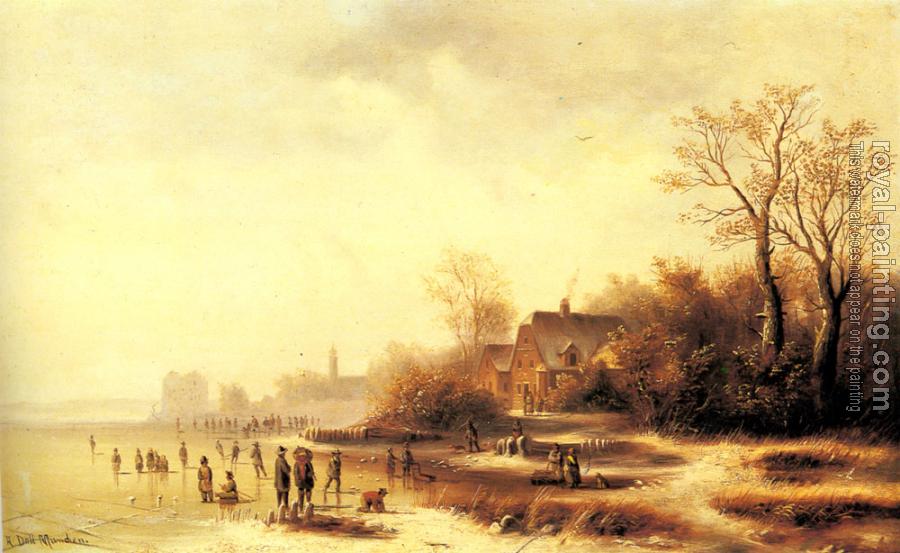
firewood even scarcer (they are high up on a mountain, and both food and firewood come from far below) somehow, but not easily. Fortunately, the city is also heated in places by a few hot springs. And as those few who have dared to venture below into the sewer systems have discovered, the deeper and more ancient tunnels (the current occupants discovered the long unused city and colonized it under duress not long before the time of play), were quite a bit warmer than expected. No one has gone particularly far down in the tunnels (and returned to tell the tale) thus far, by the way.
So winter in Hobbington is a trial by ice for most of the people who live there. In particular, the many sallow-faced orphans who beg in the streets, their tatters held tight around them, following after the few "Rat Stick" vendors, hoping for a hand out or a fallen piece of hot greasy meat. Snow can come up to the waist in some places. The wind is often bitterly freezing, and hungry, snacking on fingers and toes with its frostbite-teeth whenever the opportunity arises (yes, the elements are often treated as something like anthropomorphic beings in Elthos). And so, you would find that life in Hobbington in the winter is quite harsh, indeed, and winter storms and ice blasts there frequent and dire.
On the other hand, for some in Hobbington, although the winter is harsh, it is not without it's joys. There are the winter festivals which center on Holy Days and Shrines to the Saints, and some people who have the wherewithal (the rich, as one might guess) do manage to have a bit of fun skating on the frozen canals that line the township, play winter games, and hold various intellectual contests and events that are best held indoors. Winter, by those in the know, is considered "High Political Season" in Hobbington, as audiences tend to be captive. The Player Characters, of course, deal with all of this by bundling up as best as possible, and hustling and bustling from place to place, like everyone else, in order to dodge back inside to cozier climes, such as the hearth of a local pub, tea shop, temple, or home.
In the latest adventure, as a matter of fact, the Party left Hobbington to go down the Long Stair to the Provinces. Winter is harsh there, too, they soon found out. Snow drifts can be chest height, and a lack of paved roads make the going painfully slow. Frostbite is a perpetual possibility. There are few places to spend a warm night, and so camping equipment such as warm tents are essential. Twice the Party got engulfed in snow storms during their travels and nearly got lost in the white haze. Fortunately, they wisely prepared themselves with the appropriate winter gear. At the worst they traversed an area of hills south of Hobbington which has huge ruts and deep ravines, covered by snow, with fathomless pits leading down into the dark icy depths. Crossing one of those ravines was almost the end of several of the Characters as they in inadvertently (and quite unwisely, I thought) chose to tether themselves with ropes to the largest party member (huge), who also happened to be the clumsy oaf of the group, Bantum. Had it not been for their good luck, they'd have been plunged down the ravine with him. Fortunately, although he slipped, he did not go over the edge into the dark icy abyss below, nor bring them all careening downward with him.
Furthermore, Elthos is populated with various breeds of monsters that could be described as Wintery. There are Frost Giants, of course. And their diminutive, albeit hardly less deadly cousins, the Frost Ogres, who are hunters and pray on the unwary winter travelers like wolves. But perhaps the most persistently dangerous enemies in the forests around Hobbington are none other than the Wolves themselves. They are cunning hunters, cruel, and as deadly foes as you'd care to meet. And in winter with the snow slowing everyone's movement to a crawl, attack levels thwarted by frozen limbs, and numbed fingers... well, you can imagine. It can be quite harrowing.
And so Winter is treated in my world as a form of deadly terrain, personified, with monsters. A hostile one, generally, for Adventurers. Hint-to-the-wise: it might be better to start a Campaign in the Spring time after all. ;)
At deeper level, another Winter has crept into my world in the idea of the Winter King. In ancient Celtic Lore, as I understand it from reading lots of books by Caitlin and John Matthews there was a long standing myth of the
Winter King who in some sense, it is thought, represents the Old Order of things, a King past his prime, one who is soon to be inevitably replaced by the next generation - that of the new and rising Sun King, or the Prince of Spring. The myth, of course, is tied to the changing of the seasons and the renewal of life after the bleak months of winter. As such, the myth of the Winter King is infused with the Mysteries of Transformation and Magic, and speaks to the ancient belief of the cyclical nature of Life and Death, and Life and Death, and Life and Death... Taking this idea I have woven something along these lines into the deeper layers of the Elthos back story. Elthos, as some of my readers may know, is as much a fairytale World as it is anything else. And so the conflict between the Winter King and the Prince of Spring who struggle for the hand of Sovereignty, (aka Flower Maiden), is complex and rich with diverse and ancient themes. These themes show up occasionally in Elthos Campaigns as Player Characters sometimes (rarely, I admit) come in contact with the Mythological Beings that permeate the world. Those encounters, if all goes well, may reveal something of the mythological underpinnings of the Elthos World, and what the true nature of the Elthos story really is. Rare, but it has been known to happen. Of course I've already given a bit more away than I intended. I'll stop there, if you don't mind. I wouldn't want to spoil anything for my players, you know.
So in conclusion, on the overt side, Winter is a dire opponent of Adventurers, a bane of travel, and can just as easily bring death and ruin as any giant or invading army. On the other hand, Winter in Elthos is also a Mythic Being of great importance, a sustainer of the Universal Order of things, often wise, often bitter, and always someone, or something, to pay one's utmost respect to.
On the Joys & Challenges of developing the Elthos RPG & Mythos Machine, and other sundry RPG matters.
Wednesday, February 05, 2014
Thursday, January 23, 2014
On RPG Systems, Rules and Homebrews
Preface - upon re-reading I have found out a few things about the history of our beloved hobby that I didn't know until quite recently, and happen to have altered some of the views I express in this writing. I expect to continue to do so over time, and so I may edit this with additional notes as new understandings arise.
When I got started with D&D in 1978 we had three little booklets to work off of. 'Men & Magic', 'Monsters & Treasure', and 'Wilderness Adventures'. I still have my copy of those rules. I find in the introduction paragraph our great sage and leader, Gary Gygax included the following note.
In that spirit many of us pioneering Gamesmasters in the old days, before AD&D came out, created our own worlds, and our own rules systems. In fact in my town we had a fledgling Gamesmaster's Society and the entry criteria was "Anything but Gygax". We could use the three books as a basis, but every GM was expected to come up with their own version, fixing what we all considered to be fundamental design flaws in the original system. I did likewise, and within a month or two had worked out what I felt was a coherent, and easy to manage, flexible, and elegant solution to what I thought was the most fundamental design flaw of all in original D&D. The flaw was a function, I felt, of the TSR business model. I'll get back to that in a minute.
We had another reason for wanting to create our own rules systems. Early on GMs noticed that some Players had a tendency to want to rules lawyer the games, and second guess the GMs (see note 1 below). So when a monster was sighted, the Rules Lawyer in the group would know all the stats of the thing, and have a good technical idea of how to maximize the party's chances of beating it. I'm not saying that this is a bad thing. But we GMs didn't care for it. We felt it kind of ran against where we wanted to go with the game. Which was toward story, not towards mechanics. We wanted the Players to focus on their Characters personalities, motives, and relationships, not their stats. A lot of people later on said that D&D was not designed for story, it was designed for Gaming. Well, I somewhat beg to differ on that. It was the first attempt towards what I will refer to as Story-Gaming. Before that the closest thing we had was Chainmail, which was a medieval military war game that used miniatures, and had very specific combat rules, and was indeed Gameist in nature. But D&D was a first shot at a more Story oriented game. It definitely is Gamist in that it had rules based loosely off of Chainmail, but it's concept was to merge game and story. At least that's how we all took it in those days. As such I would say that D&D was by design intent a Story-Game based on was Tolkien's 'Lord of the Rings'.
To return to my earlier point, the fundamental design flaw was the TSR business model. It ran against the grain of the Story-Game orientation of the original intent. The business model, of course, was to sell rules books. And to justify those sales the rules, I knew intuitively, would have to become more complex, and continuously change. This would, of course, cause us GMs to have to alter our Worlds as the rules systems changed. Magic? Totally changed. But if I had a world where famous Characters had used certain mystic powers to defeat an ancient threat, but those mystic powers were no longer in Rules Version 8.3... what would I do? I'd freak out, that's what. I wanted from the beginning a continuous long term campaign that wouldn't be vulnerable to the vagaries, flaws and alterations that would inevitably come down from TSR over the years. I'm sure that other GMs who I knew felt the same way at the time.
And so what we wanted was a simple, flexible rules system that would allow us to play out RPG Stories. We didn't want it to get in the way. We didn't want it to take over and become the primary focus. In fact, to avoid that effect we not only created our own rules, but we often obscured them away from the players. For many years I hid my rules from my Players. I hid their Character's stats from them, too. Instead of giving them a number for their Character's Strength, I would simply say, "He's stronger than average", "She's wiser than the hoot owl", "He's a clumsy oaf, but has the gift of gab", and so on. Guess what? The players absolutely didn't mind. I explained that I wanted the game to focus on story, and they were cool with that.
It wasn't for many years that I finally let my Players in on the rules. I did so because my interests evolved. I wanted to work on certain aspects of the rules system to iron them out, and balance them. To do that I wanted Player feedback. I explained, "I'm going to share the rules with you guys, and I would like to get your feedback on them in relation to combat tactics and game balance." They were totally cool with that, too. And so for the remainder of my GMing time I've been ironing out, simplifying and balancing them, with my Players help. It's been great. I know use a 1d6 system with one central General Resolution Matrix. Actually, the GRM I came up with back in 1978, but the 1d6 system was something I worked out between 2006 and 2013. (Don't rush me, I'm a slow poke).
After AD&D the industry took the expected turn for the worse in terms of rules complexity and what I think could fairly be called Anti-Modularity. Every system that came out was more complicated than the last, while purporting to fix the flaws of the previous system. Instead of tweaking towards simplicity the designers chose to revamp towards complexity. That's ok. There's a lot of folks who adore one or more of those systems, and don't mind the periodic World-overhaul involved with changing the systems. For me, though, and GMs of my ilk, it just didn't quite cut it. I guess it's because we were there in the beginning, saw the original rules and a launching point for our own systems, and went at it with a gusto. I've seen a myriad of wonderful variations on original D&D. Many of them were enormously creative adaptations. I've even co-opted a few of the ideas I found along the way. You'll find, for example, a certain resemblance between the numerics of my magic system and that of David Kahn's Telthanar. ;) Overall, I'm pro-Homebrew. While I'm not anti-other-systems, I have a definite preference for the local variety of creativity that comes with designing your own RPG rules system.
The upshot is that I'm interested in what other Homebrew style GMs have done over the past 30 years. If you've created and are running a homebrew system, drop a line. I'd love to hear about it!
Notes:
1. According to Men & Magic Introduction p.4 - If you are a Player, the author (Gygax / Arneson) approves and recommends you read the rules in order to gain "great advantage" during the game that might otherwise evade you. "A quick check of some rule or table may bring hidden treasure or save your game 'life'". Hence at the very beginning it seems Gygax encouraged (without so much as realizing it, perhaps) Rules Lawyering and Munchkinism. This in fact has to have been (I think) an outcome of the TSR business model - sell as many rules books as possible, which necessarily (and unnecessarily) spawned many evils. Naturally, Gygax wants to encourage Players to buy the rules as the expectation was that there would be 20 Players for each Referee, and TSR would rely on rules book sales to generate revenue for the company. Wouldn't you encourage Rules Lawyers, too? I'm sure we all would. Unfortunately. On the other hand things could have gone differently, but that's a topic for another blog post.
When I got started with D&D in 1978 we had three little booklets to work off of. 'Men & Magic', 'Monsters & Treasure', and 'Wilderness Adventures'. I still have my copy of those rules. I find in the introduction paragraph our great sage and leader, Gary Gygax included the following note.
"These rules are as complete as possible within the limitations imposed by the space of three booklets. That is, they cover the major aspects of fantasy campaigns but still remain flexible. As with any other set of miniatures rules they are guidelines to follow in designing your own fantastic-medieval campaign. They provide the framework around which you will build a game of simplicity or tremendous complexity your time and imagination are about the only limiting factors."
In that spirit many of us pioneering Gamesmasters in the old days, before AD&D came out, created our own worlds, and our own rules systems. In fact in my town we had a fledgling Gamesmaster's Society and the entry criteria was "Anything but Gygax". We could use the three books as a basis, but every GM was expected to come up with their own version, fixing what we all considered to be fundamental design flaws in the original system. I did likewise, and within a month or two had worked out what I felt was a coherent, and easy to manage, flexible, and elegant solution to what I thought was the most fundamental design flaw of all in original D&D. The flaw was a function, I felt, of the TSR business model. I'll get back to that in a minute.
We had another reason for wanting to create our own rules systems. Early on GMs noticed that some Players had a tendency to want to rules lawyer the games, and second guess the GMs (see note 1 below). So when a monster was sighted, the Rules Lawyer in the group would know all the stats of the thing, and have a good technical idea of how to maximize the party's chances of beating it. I'm not saying that this is a bad thing. But we GMs didn't care for it. We felt it kind of ran against where we wanted to go with the game. Which was toward story, not towards mechanics. We wanted the Players to focus on their Characters personalities, motives, and relationships, not their stats. A lot of people later on said that D&D was not designed for story, it was designed for Gaming. Well, I somewhat beg to differ on that. It was the first attempt towards what I will refer to as Story-Gaming. Before that the closest thing we had was Chainmail, which was a medieval military war game that used miniatures, and had very specific combat rules, and was indeed Gameist in nature. But D&D was a first shot at a more Story oriented game. It definitely is Gamist in that it had rules based loosely off of Chainmail, but it's concept was to merge game and story. At least that's how we all took it in those days. As such I would say that D&D was by design intent a Story-Game based on was Tolkien's 'Lord of the Rings'.
To return to my earlier point, the fundamental design flaw was the TSR business model. It ran against the grain of the Story-Game orientation of the original intent. The business model, of course, was to sell rules books. And to justify those sales the rules, I knew intuitively, would have to become more complex, and continuously change. This would, of course, cause us GMs to have to alter our Worlds as the rules systems changed. Magic? Totally changed. But if I had a world where famous Characters had used certain mystic powers to defeat an ancient threat, but those mystic powers were no longer in Rules Version 8.3... what would I do? I'd freak out, that's what. I wanted from the beginning a continuous long term campaign that wouldn't be vulnerable to the vagaries, flaws and alterations that would inevitably come down from TSR over the years. I'm sure that other GMs who I knew felt the same way at the time.
And so what we wanted was a simple, flexible rules system that would allow us to play out RPG Stories. We didn't want it to get in the way. We didn't want it to take over and become the primary focus. In fact, to avoid that effect we not only created our own rules, but we often obscured them away from the players. For many years I hid my rules from my Players. I hid their Character's stats from them, too. Instead of giving them a number for their Character's Strength, I would simply say, "He's stronger than average", "She's wiser than the hoot owl", "He's a clumsy oaf, but has the gift of gab", and so on. Guess what? The players absolutely didn't mind. I explained that I wanted the game to focus on story, and they were cool with that.
It wasn't for many years that I finally let my Players in on the rules. I did so because my interests evolved. I wanted to work on certain aspects of the rules system to iron them out, and balance them. To do that I wanted Player feedback. I explained, "I'm going to share the rules with you guys, and I would like to get your feedback on them in relation to combat tactics and game balance." They were totally cool with that, too. And so for the remainder of my GMing time I've been ironing out, simplifying and balancing them, with my Players help. It's been great. I know use a 1d6 system with one central General Resolution Matrix. Actually, the GRM I came up with back in 1978, but the 1d6 system was something I worked out between 2006 and 2013. (Don't rush me, I'm a slow poke).
After AD&D the industry took the expected turn for the worse in terms of rules complexity and what I think could fairly be called Anti-Modularity. Every system that came out was more complicated than the last, while purporting to fix the flaws of the previous system. Instead of tweaking towards simplicity the designers chose to revamp towards complexity. That's ok. There's a lot of folks who adore one or more of those systems, and don't mind the periodic World-overhaul involved with changing the systems. For me, though, and GMs of my ilk, it just didn't quite cut it. I guess it's because we were there in the beginning, saw the original rules and a launching point for our own systems, and went at it with a gusto. I've seen a myriad of wonderful variations on original D&D. Many of them were enormously creative adaptations. I've even co-opted a few of the ideas I found along the way. You'll find, for example, a certain resemblance between the numerics of my magic system and that of David Kahn's Telthanar. ;) Overall, I'm pro-Homebrew. While I'm not anti-other-systems, I have a definite preference for the local variety of creativity that comes with designing your own RPG rules system.
The upshot is that I'm interested in what other Homebrew style GMs have done over the past 30 years. If you've created and are running a homebrew system, drop a line. I'd love to hear about it!
Notes:
1. According to Men & Magic Introduction p.4 - If you are a Player, the author (Gygax / Arneson) approves and recommends you read the rules in order to gain "great advantage" during the game that might otherwise evade you. "A quick check of some rule or table may bring hidden treasure or save your game 'life'". Hence at the very beginning it seems Gygax encouraged (without so much as realizing it, perhaps) Rules Lawyering and Munchkinism. This in fact has to have been (I think) an outcome of the TSR business model - sell as many rules books as possible, which necessarily (and unnecessarily) spawned many evils. Naturally, Gygax wants to encourage Players to buy the rules as the expectation was that there would be 20 Players for each Referee, and TSR would rely on rules book sales to generate revenue for the company. Wouldn't you encourage Rules Lawyers, too? I'm sure we all would. Unfortunately. On the other hand things could have gone differently, but that's a topic for another blog post.
Monday, December 09, 2013
Elthos Imagination Machine
As some of you know I've been working on the Elthos Project for quite a long time now. A really good long time. It's been great. I'm finally at the point now where I feel comfortable opening up the system to a wider audience than my few play testers. Having done a bit of poking around I'm leaning towards "The Elthos Imagination Machine" as a working title for the system. The Elthos RPG is located at http://www.Elthos.com in case you care to take a preemptive peek at the thing. Don't be shy.
Anyway, for those who have a kind of geeky interest in the history and intention of the thing here's a quick chronology of my progress thus far with the project:
OK... I'm a slow poke... don't rush me. It's been a lot of fun though, actually. And a great learning experience. In fact I built my programming career around working on this game system. At this point both the rules and the web application are stable. I'm pretty excited about it. I'm going to open the system up for general beta testing in 2014, and will be publishing the related materials at the same time. I hope people will find it both enjoyable and useful for managing their RPG Worlds.
The ODS is a rules light system that adheres to the traditional OD&D tropes. Sure I know a lot of people have moved on from that and are using all kinds of fancy newfangled RPG innovations, and that a lot of folks are looking for alternative mechanics. There's lots and lots of RPGs with innovative mechanics, most notably among the Indie Revolution which I believe is still going strong.
Elthos, however, has gone the other way. Its intention has been to clarify, simplify and consolidate the traditional system and make it a cleaner, easier system to run. I've always been fond of the traditional take on the game, and still am. I like Levels, Hit Points, Classes and stuff. It works for me both as a player and as a Gamesmaster. I also am lead to believe that it also continues to work for many other people and is the foundation of what I think is being called the Retro Movement..., and so my hope is that in it's own Retro way, Elthos will appeal to people who are looking for a traditional light weight system. One that comes with Substantial Computer Support. Not just a little bit, either.
The Elthos ODS Web Application's most generally useful features will probably be found in the World Weaver's Development Studio. It allows Gamemasters to create their own worlds, by importing a default world with a selection of default fantasy genre items (weapons, armors, equipment, classes, etc). They can also elect to create a "Minimalist World" which only has one item in each category as an example, and from there the GM can create whatever their hearts desire. Everything created ties into the systems calculation engine so that everything the GM creates for their worlds integrates smoothly. The nice thing about the World Weaver's Development Studio is that it stores everything about people's Worlds online where you can get at it from anywhere, and not lose stuff over time ... which always used to happen to me. Where did those notebooks go to? Bah. Not anymore. :)
The other side of the coin is the Gamesmaster's Toolbox that allows Players to manage their Characters online, and lets the Gamesmaster run all kinds of functions that are helpful during the course of a game. The Toolbox rolls characters, or randomly generates adventure groups. It allows Players to interact with their Characters online to select their skills and powers when they go up in Levels, and manage their Character's description, history, and equipment.
Between the two sides of the coin, and I'm only giving a light weight description here, it's about as comprehensive a system as I've seen out there so far. Of course it fills it's own niche so it doesn't do things that other systems such as Roll20 do, though Elthos could be used in conjunction with those other systems on the back end, so to say. That's how I intend to use it myself. I think it will be ideal for use with Google Hangouts and Roll20, actually. I'm planning to try that out soon.
Anyway, the upshot is, lots of progress has been made, and I'm now ready, finally, to go to Phase II of the project. And that involves opening it up to the public for use and feedback. When it goes Open Beta I will make an announcement on this blog.
So at this point I want to say ... Many many many thanks to all of the people who have play tested, and helped me with the rules system and programming along the way! Thank you!!!
Anyway, for those who have a kind of geeky interest in the history and intention of the thing here's a quick chronology of my progress thus far with the project:
| 1978 | Created Elthos Prime Rules based on OD&D |
| 1994 | Began programming the Elthos Prime Rules in QBasic & Visual Basic |
| 1995 | Professional Gamesmastering (Elthos RPG at local Community Center) (made $600 in 6 weeks!) |
| 1996 | Joined International Game Developers Association (wrote articles on RPGing for their Magazine) |
| 1997 | Began working as a programmer / analyst and working on Elthos as my nighttime hobby-job |
| 2000 | Finished the Elthos Prime application in Visual Basic. |
| 2004 | Professional Gamesmastering - Hamfest - Weasel King Campaign (made $1360 in 12 weeks!) |
| 2006 | Founded the Literary Role Playing Game Society (LRPGSW) |
| 2007 | Created the Elthos One Die System (ODS) to run mini-games for the LRPGSW |
| 2008 | Completed PDF |
| 2009 | Completed Elthos RPG Web Application V1.0 in ASP.Net - Closed Beta |
| 2009 | Game Testing - Hamfest - The Rescue of Lord Beltane Campaign - Revisions to 1.2 |
| 2010 | Game Testing - Hamfest - The Bellowick Campaign - Revisions to 1.3 |
| 2011 | Game Testing - Hobbington - The Hagglesmith Campaign - Revisions to 1.4 |
| 2012 | Game Testing - Hobbington - The Dragon Stone Campaign - Revisions to 1.5 |
| 2013 | Completed Elthos ODS RPG Web Application - Prepping for Open Beta in 2014 |
| 2013 | Completed work as a Programmer / Analyst and switched to Business Mode for Elthos. |
OK... I'm a slow poke... don't rush me. It's been a lot of fun though, actually. And a great learning experience. In fact I built my programming career around working on this game system. At this point both the rules and the web application are stable. I'm pretty excited about it. I'm going to open the system up for general beta testing in 2014, and will be publishing the related materials at the same time. I hope people will find it both enjoyable and useful for managing their RPG Worlds.
The ODS is a rules light system that adheres to the traditional OD&D tropes. Sure I know a lot of people have moved on from that and are using all kinds of fancy newfangled RPG innovations, and that a lot of folks are looking for alternative mechanics. There's lots and lots of RPGs with innovative mechanics, most notably among the Indie Revolution which I believe is still going strong.
Elthos, however, has gone the other way. Its intention has been to clarify, simplify and consolidate the traditional system and make it a cleaner, easier system to run. I've always been fond of the traditional take on the game, and still am. I like Levels, Hit Points, Classes and stuff. It works for me both as a player and as a Gamesmaster. I also am lead to believe that it also continues to work for many other people and is the foundation of what I think is being called the Retro Movement..., and so my hope is that in it's own Retro way, Elthos will appeal to people who are looking for a traditional light weight system. One that comes with Substantial Computer Support. Not just a little bit, either.
The Elthos ODS Web Application's most generally useful features will probably be found in the World Weaver's Development Studio. It allows Gamemasters to create their own worlds, by importing a default world with a selection of default fantasy genre items (weapons, armors, equipment, classes, etc). They can also elect to create a "Minimalist World" which only has one item in each category as an example, and from there the GM can create whatever their hearts desire. Everything created ties into the systems calculation engine so that everything the GM creates for their worlds integrates smoothly. The nice thing about the World Weaver's Development Studio is that it stores everything about people's Worlds online where you can get at it from anywhere, and not lose stuff over time ... which always used to happen to me. Where did those notebooks go to? Bah. Not anymore. :)
The other side of the coin is the Gamesmaster's Toolbox that allows Players to manage their Characters online, and lets the Gamesmaster run all kinds of functions that are helpful during the course of a game. The Toolbox rolls characters, or randomly generates adventure groups. It allows Players to interact with their Characters online to select their skills and powers when they go up in Levels, and manage their Character's description, history, and equipment.
Between the two sides of the coin, and I'm only giving a light weight description here, it's about as comprehensive a system as I've seen out there so far. Of course it fills it's own niche so it doesn't do things that other systems such as Roll20 do, though Elthos could be used in conjunction with those other systems on the back end, so to say. That's how I intend to use it myself. I think it will be ideal for use with Google Hangouts and Roll20, actually. I'm planning to try that out soon.
Anyway, the upshot is, lots of progress has been made, and I'm now ready, finally, to go to Phase II of the project. And that involves opening it up to the public for use and feedback. When it goes Open Beta I will make an announcement on this blog.
So at this point I want to say ... Many many many thanks to all of the people who have play tested, and helped me with the rules system and programming along the way! Thank you!!!
"Festina lente."
- Augustus Caesar
Wednesday, October 02, 2013
There's No Place Like Home...
This month's RPG Carnival is about 'Spooky Spots' ...
http://ofdiceanddragons.com/october-2013-blog-carnival-spooky-spots/
First, thanks to Scot Newbury for hosting this month and the interesting topic! Reading the post reminded me of a really spooky experience I had one night ... at home. Very spooky.
I grew up in an upper class neighborhood about sixty miles north of New York City. We had been living there for about five years by the time this occured, and nothing in particular ever struck me as spooky in the least. Oh there was the copperhead snake in the front yard one time, but that's just scary, not spooky.
One night I was sitting in my bedroom. I wasn't doing anything memorable, just some studying for a math exam coming up later in the week. I looked up at the window in front of my desk. It was reflecting the light from my desk lamp. Beyond was darkness, as the sun had set about an hour earlier. I recall a very faint dark blue line sillouetting the treeline on the road that passed in front of my house, and the road itself was obscured by shadows and trees but I could dimly make it out as a dark gray line. It was, as I recall, a clear night and windless.
As I gazed at the window for some reason I began to get the impression that there was something out on the road; a darker than shadow shape perhaps, standing, or squating there across from my window. It gave me the impression of being rather large, the size of bear maybe? I turned out my light. But nothing stirred. I couldn't actually see anything. It seemed to be squating on the road and remained motionless except for what I thought was a slight swaying. It gave me the distinct feeling that it was watching me. Staring into my bedroom. I had no idea how long it had been there. I suddenly got very tense.
Then for some reason I can't explain I got the impression it wasn't a bear at all. Or a person. Or anything I'd ever encountered before. Perhaps there was a faint sound that came from the road, I don't know. Suddenly all the hairs on the back of my neck stood up on end, and I got goosebumps over my whole body. Whatever it was on the road in front of my house was far larger than a bear. I have no idea why but I felt that it had droped down from the sky. I would have sworn that it had wings. Again, perhaps because I heard something that sounded like the slow flapping sound of giant wings, the way a bird on the ground might do to steady itself against a wind. But there was no wind. A sweat broke out on my neck and head. I began having trouble breathing. I stared as hard as I could into the darkness. I couldn't see anything. Only that sound coming in through the bottom of the window. And the feeling, that horrible feeling, that something very large, and very old and very, very evil was standing on the road with it's eyes directly on me. I had the impression that it had come with the specific intent to land in front of my house on Silver Lane and stare at me. For some ... horrible reason.
Then, as suddenly as that, it vanished. I didn't see any movement on the road, or hear whoosh of air, but the sound was no more and the darker than dark patch that seemed to move slightly from side to side returned to a normal patch of shadow on the road.
It was one of the most frightenning experiences I've ever had. It turned my normal, safe and cozy family home into one of the spookiest places I'd ever known. For one short dreadful moment that night. After that it never happened again, and my home returned once more to it's cozy normal state, although I don't think I slept a wink for several days afterwards. I never sensed whatever it was again ... except once, many years distant when I was hiking in the mountains of California nestled around a campfire with an old wizardish friend of mine. But that's fare for another story, another time. Right now I have to go shake off this memory and have a drink.
http://ofdiceanddragons.com/october-2013-blog-carnival-spooky-spots/
First, thanks to Scot Newbury for hosting this month and the interesting topic! Reading the post reminded me of a really spooky experience I had one night ... at home. Very spooky.
I grew up in an upper class neighborhood about sixty miles north of New York City. We had been living there for about five years by the time this occured, and nothing in particular ever struck me as spooky in the least. Oh there was the copperhead snake in the front yard one time, but that's just scary, not spooky.
One night I was sitting in my bedroom. I wasn't doing anything memorable, just some studying for a math exam coming up later in the week. I looked up at the window in front of my desk. It was reflecting the light from my desk lamp. Beyond was darkness, as the sun had set about an hour earlier. I recall a very faint dark blue line sillouetting the treeline on the road that passed in front of my house, and the road itself was obscured by shadows and trees but I could dimly make it out as a dark gray line. It was, as I recall, a clear night and windless.
As I gazed at the window for some reason I began to get the impression that there was something out on the road; a darker than shadow shape perhaps, standing, or squating there across from my window. It gave me the impression of being rather large, the size of bear maybe? I turned out my light. But nothing stirred. I couldn't actually see anything. It seemed to be squating on the road and remained motionless except for what I thought was a slight swaying. It gave me the distinct feeling that it was watching me. Staring into my bedroom. I had no idea how long it had been there. I suddenly got very tense.Then for some reason I can't explain I got the impression it wasn't a bear at all. Or a person. Or anything I'd ever encountered before. Perhaps there was a faint sound that came from the road, I don't know. Suddenly all the hairs on the back of my neck stood up on end, and I got goosebumps over my whole body. Whatever it was on the road in front of my house was far larger than a bear. I have no idea why but I felt that it had droped down from the sky. I would have sworn that it had wings. Again, perhaps because I heard something that sounded like the slow flapping sound of giant wings, the way a bird on the ground might do to steady itself against a wind. But there was no wind. A sweat broke out on my neck and head. I began having trouble breathing. I stared as hard as I could into the darkness. I couldn't see anything. Only that sound coming in through the bottom of the window. And the feeling, that horrible feeling, that something very large, and very old and very, very evil was standing on the road with it's eyes directly on me. I had the impression that it had come with the specific intent to land in front of my house on Silver Lane and stare at me. For some ... horrible reason.
Then, as suddenly as that, it vanished. I didn't see any movement on the road, or hear whoosh of air, but the sound was no more and the darker than dark patch that seemed to move slightly from side to side returned to a normal patch of shadow on the road.
It was one of the most frightenning experiences I've ever had. It turned my normal, safe and cozy family home into one of the spookiest places I'd ever known. For one short dreadful moment that night. After that it never happened again, and my home returned once more to it's cozy normal state, although I don't think I slept a wink for several days afterwards. I never sensed whatever it was again ... except once, many years distant when I was hiking in the mountains of California nestled around a campfire with an old wizardish friend of mine. But that's fare for another story, another time. Right now I have to go shake off this memory and have a drink.
Wednesday, September 18, 2013
When Science Catches Up With Your World
I got a bit of a thrill today when I found an article in Daily Science that validated something that I've done a few times in my world. The story ... our Heroes had been shrunk down to tiny size and were riding on the backs of aphids through a tangle of vines on the wall of an old ruined tower in order to escape the deadly attack of a wolf-wizard and his shadow-dogs. Whenever they got within range of a human they noticed that their gigantic opponent seemed to move much more slowly than in 'real life', and they were able to spring away in time to escape.
As it happens my sci-fi conjecture for my world turns out to be exactly how insects escape from human attacks!
http://www.sciencedaily.com/releases/2013/09/130916102006.htm
Neat. :) How cool is that? Ever have that experience with your world?
As it happens my sci-fi conjecture for my world turns out to be exactly how insects escape from human attacks!
http://www.sciencedaily.com/releases/2013/09/130916102006.htm
Neat. :) How cool is that? Ever have that experience with your world?
Tuesday, September 17, 2013
A New World - The Present
| The Vigilantes |
We've got four Vigilantes - Pericles the Mexican Wrestler and Saint of Luche, Scotty the wild roughian, The Paladin the religious zealot on a mission from God, and Black Out, a kid with technical savvy and a hyped up sense of idealism. And a mysterious benefactor, named The Patron.
So far we've had three adventures. The first one was our introduction where we met the Patron and setup our HQ in an old warehouse on the edge of town. The second was where we investigated an attack on a local Synagogue by Skin Heads. The third where we were setting up cameras around a nearby Synagogue and wound up in a violent confrontation with the Skin Heads. Luche was the first to attack, but it was definitely Scotty who had the most impact on the villains. Three of them died. One by Scotty backing up their own van (white) over one, and the other two who died when Scotting backed the van up the stairs into the doorway of the then burning Synagogue. The rats had thrown Molotov cocktails into the place, and Scotty, well, got his revenge, though he didn't intend to actually kill them. The next adventure was the escape, which didn't go as well as I'd hoped. Black Out wound up being caught by the police, but because he's under age, and pretended not to know anything, they let him go. He got a real ear chewing from his mom. And that's when he decided to leave home, and go live at the HQ so he could pursue his Vigilante goals. All the while questioning whether or not Vigilantism is truly noble, or not.
It's been really fun, and really interesting! What do you think of Costumed Vigilantes? A noble cause in a time of Chaos - or a can of worms destined to turn?
Credit: The above drawing was done by one of the Play Testers, Milo Barasorda (playing Pericles), a phenomenal RPGer, and artist! Thanks Milo!
Friday, September 06, 2013
How Tolkien Leads the Digital Revolution
I ran across this article today... hmmm... rather interesting how Tolkien's awesomeness has influenced the world, isn't it?
How Tolkien Leads the Digital Revolution
Subscribe to:
Posts (Atom)


