Tuesday, December 20, 2016

Some Thoughts on Escapism

Some random thoughts that come to mind while reading Jens D's very interesting and thought provoking post here.

The question of escapism requires context in order to discern whether it is useful or detrimental. By itself it is unclear which way it should be considered as it has both a positive and negative aspect. For example, escapism when in jail, certainly, is a positive. However, escapism when reality requires your attention is a negative. As an example, those who escape into fantasy worlds (to the extreme) and wind up missing work, and (in some cases) living degraded lives in their mom's basement playing World of Warcraft... that would be rightfully considered a negative. So... whether escapism is useful and a good thing, or detrimental and a bad thing depends on who is using it, when, and for what purpose, and to what effect. In other words - it's complicated.

Stories are indeed important. However, they are not important because of their entertainment value, although that is what makes them useful (which is to say that is why people listen to them). They are important because they teach valuable lessons about life. For example, that prehistoric caveman around the fire telling the story of the wild buffalo and how he overcame it with his "new fangled" arrow (the older geezers probably grumbling about how in the old days they had to use their teeth to slay the buffalo) taught the youth that arrows are a good and heroic thing.

But furthermore, and this is where it gets really weird, the stories of the ancients very often dealt with completely impractical matters such as The Gods, and the dawn of existence, and this sort of thing. But laden in those stories were a lot of lessons about morality. And that's really why they were told, I think. Now we might look at those stories of The Gods and wonder what the heck kind of morality they had, seeing has how they were pretty wild, incestuous, and power-crazed (apparently), but we can't really fathom from here what the minds of our ancestors thought, and what their hearts felt, when they originally heard these stories for the first time. We can't possibly expect to superimpose our 21st century emotions, moralities, and thoughts on the distant past that way and imagine that we can understand any of their feelings or thoughts. We'd be bone headed stupid to assume we can understand any of it from their point of view.

Speaking of which... Imagination. Fantasy is all about imagination, and that's been going on since the dawn of man. But the reaction against it, which appears to culminate in the accusation of escapism, is unfairly targeted at the Industrial Age. In fact, warnings against the imagination are founded in none other than the Bible.
"And GOD saw that the wickedness of man was great in the earth, and that every imagination of the thoughts of his heart was only evil continually."
- Genesis 6:5
Now some people might say "oh well that's why Religion is so bad... how can people cast aspersions on Imagination?!" But I think that would be an overly simplistic conclusion to draw. The ancients who wrote all of those stories that we so love include those that are found in the Bible, many of which actually predate the Bible and come from Summarian culture anyway. They are some of the oldest and most profound stories in the world. So we shouldn't lightly discount them as if we are all so smart. We should, I think, try to understand them as best we can. There may be hidden nuggets of wisdom there, after all.

But lets put Imagination in the Biblical context for a moment to see why, and how important it was. It was the imagination of man that produced, after all, the technological wonder of the Tower of Babel, which "reached the heavens". What this story is about, the lesson, I think, is that man is too immature, to petty, selfish, and cruel to obtain God-like Technological Power. It was, from God, a big warning when He cast down the Tower of Babel and thwarted the once unified language of man. It was to prohibit, perhaps, the ultimate evil - that the imagination of man would create technologies that could destroy the entire world. Or worse - the Universe itself (tampering with the boson higgs field comes to mind: http://www.livescience.com/47737-stephen-hawking-higgs-boson-universe-doomsday.html).

So the power of the Imagination is great... and it could be our ultimate doom. And that might be why the Bible warns us about it, and against its use.

But that takes me back to the Bible itself - a collection of stories. Which employ the use of the imagination. We visualize these stories in order to understand them, and God, apparently, gave us the ability and power to do so, as well as the Bible itself with which we are obviously intended to use our imaginations. So imagination, although unwieldy and potentially dangerous, is also intrinsic to our being. It is the God-like power that divinity grants to mankind, and that's how Tolkien saw it. Which is why he was an advocate of Mythopoeia. Again, just like with escapism, Imagination is complicated.

What Tolkien and CS Lewis, Owen Barfield, and the rest of the Inklings were concerned with was the use of the Imagination to produce Good, rather than evil. And as stories can, and should, teach valuable lessons, and not the least of which are lessons about morality, they should be considered to be a Good use of the Imagination. Just as we would have to conclude that the Bible itself is a Good use of the Imagination.

Another thing to consider that Jens D's post brought to mind is that Tolkien lived through both WWI and WWII... he fought in WWI on the front lines and at the Somme. He was a man who lived through the absolute worst that human imagination had been able to contrive to that date. We in our time, those of us who never lived through such things, have an almost impossible time understanding the world-view that was inevitably molded by such experiences. So when Tolkien rails against jailers and accuses them of being the ones who are most likely to denounce escapism, I think we should understand the context of his experience that might well have lead him to feel that in the big picture we are all in prison... with small and fruitless interludes between The Great Wars that actually define and are the reality of human life on earth. And we should also remember that he was a devout Christian, and therefore believed that the world itself is ruled by Satan, and that the true escape is to Heaven itself.

Which leads me to the last point I want to make - escapism in the service of the Good is a wonderful thing. But I can't say that it is always and absolutely a good thing. If escapism leads one to a state of depravity, which it very well can, then it's not a good thing at all. After all, one can easily jump out of the frying pan and into the fire.

So in conclusion, it is my assessment that when creating a world and adventures therein, that we also may keep these ideas in mind as well. It is my hope and goal to make my World and it's campaigns not merely entertaining, but at some level, albeit often imperceivably so, lessons of one sort or another. Whether I am successful at that is besides the point, as I can't really be the judge of the result. I'm far too biased in my own favor. So I will have to leave it for history to decide.

Thursday, December 15, 2016

The Definition of Evil in Elthos


I was curious to hear how other GMs handle the question of Evil in their worlds and campaigns. So I posted the question to Google+ and got a bunch of replies. It was very interesting to see the preponderance of answers leaning in the same direction. The original post can be found here. My reply includes how I handle Good and Evil in my world, and I thought it was probably something that deserves its own post on my blog, so here it is.
For me, since 1978 I have run things in my world the opposite way. The Gods, of which there is one for each alignment as represented by the zodiac and planets, maintain the order (stability) of the universe and there is an objective reality regarding good and evil, as well as law and chaos.

However, mortal beings are finite and can not see the objective reality. So there are no GM statements like "Orcs are Evil", though they may well be, despite possible exceptions. nor do I tell players they can't do XYZ because of Alignment conflicts. Instead they do what they want, and I track their Alignment shifts over the course of the game. So they establish their alignments by their actions. Their current and recent Alignment is what determines their relationship to the Gods. And based on this they may obtain appropriate powers, or lose them, or change them as the game progresses.

As far as play is concerned I like to toy around with moral dilemmas, but they tend to be ambiguous. For example there is an ongoing subtext regarding the conflict between mysticism, science, and the law, wherein the law views both science and mysticism as potential existential threats to civilization, and possibly life itself, while at the same time needing both for survival in a hostile universe. Player characters get caught up in the whirlwind of these conflicts but I never give a flat exposition on the nature of the thing - I simply let it play out via the PCs and NPCs words and deeds in the game. Sometimes they catch an idea from it, but most often they whirl past on their way towards completing the objectives they have set for themselves.

Obviously this conceptual framework is not as popular as I thought, though I am also going to guess I'm not at all unique in running my world this way, as that would be too good to be true. But it does seem that this style is in the (extreme?) minority, at least.
I thought I would elaborate on this here a little bit and answer my own question. How do I define Evil in Elthos?

The objective reality of my world has it that Evil is that which intentionally causes harm out of a desire for sadistic pleasure or pathological hatred for anything that is so intense as to manifest evil behaviors. Evil, in Elthos, is a primordial force, and linked to the converse of Creation, which is Destruction. Both of these are necessary for the fluctuating ebb and flow of the Universe, and so pain and suffering are as much a part of the nature of the Universe as joy and pleasure. Evil is that force which induces pain and suffering, and it manifests itself in various forms throughout the cosmos. So the intention of Evil is to cause harm and suffering. That is evil.

To contrast this to other forms of pathological behavior, one might conduct the same action, let's say torture, but for a different motive... for example the acquisition of wealth, or power, or knowledge. While such actions may have a component of evil within them, the evil aspect is the one that causes pain and suffering for its own sake. Lust for power is not in and of itself considered Evil by the Elkron (Deities) of Elthos. This is because all of the Celestial and Archetypal Elkron are each at a pinnacle of power themselves, and it is clear to them that Power alone is neither Good nor Evil. Nor is the desire to acquire power necessarily Good or Evil, as some desire Power in order to overcome Evil Beings and establish law and order. This view point is held by the Elkron in general, though there are several Elkron in the set, those that represent Evil, who may declare otherwise. But these declarations are deceptions used to fool some of their more naive followers, or trick those who might not understand these things into making poor choices, which can be turned to the evil Elkron's advantage. In any case, all of the Elkron are equally aware of the nature of Evil, its parameters and boundaries. So that's my definition of Evil for my world of Elthos.

The Cosmological Framework of the Elkron

Saturday, November 19, 2016

The Real Challenge of the Mythos Machine

The real challenge of the Mythos Machine is that it gives a great deal of power to me as the GM to create any kind of world I want, with any races, classes, equipment, and adventures I can imagine, and it is completely flexible in terms of genre and story. Space Pirates? No problem. Dinosaur-Men vs. Bat-Monsters of the Writhing Jungle World? Yup. Can do. No problem. See the challenge yet?

The challenge is that you can create anything you can imagine, and it's kind of hard to do it just right. Like in my Space Pirates world idea... what equipment really belongs in this kind of World? I can create anything I want... but what do I want? How much of it? How many variations? Why I can go hog wild with this and create a huge myriad of things that ... well, it can become something of a quandry, actually.

And so the challenge is in thinking about, carefully, wisely, what belongs in my World? For example... What kind of mystical categories might fit? What schools of magic? What spells? How the schools and the categories mix and match can create complex arrangements, and beautiful ones. But it can also create a daunting maze if you don't reign things in such a way that the pattern works clearly for you and your players.

So that's the challenge of the Mythos Machine. You have to take the building process seriously or you might wind up building something too complicated. It's a matter of judicious use of your creative capacity. You need to learn to reign your ideas in, and keep things succinct so you can balance your world and keep things manageable.

Anyway, for those who might want to try it out, the Mythos Machine is in perpetual free open beta the Mythos Machine Beta Site. It's geared for GMs who want to create their own Worlds, and provides a traditional style light-weight system named Elthos RPG to do it with. And very flexible. You can find out more about it at http://elthos.com
If you have any feedback on the rules or the Mythos Machine, there's a feedback button. Please let me know what you think. Thanks.

Tuesday, November 15, 2016

Notes on OD&D - Part 31

Time to move on to the 2nd Level Clerical "Spells"...

Men & Magic
  • p31 - Explanation of Clerical Spells - 2nd Level

Find Traps: By means of this spell the Cleric will locate any mechanical or magical traps within a radius of 3" (90'). The spell lasts 2 turns.

Interestingly this spell is not available to Magic-Users. It performs what is undoubtedly a very useful function. Of course your Cleric needs to have a good sense of when to employ this spell and I can imagine that it is very easily wasted. As there is no question of it working, however, once cast, it provides a definite assurance whether a trap is present or not. So when entering that dungeon treasure trove... this is a very good spell to have in your Cleric's toolkit. I'm for it.

I rate this spell 4 Stars out of 5 for usefulness.

Hold Person: This spell is the same as that for Magic-Users except that it's duration is 9 turns and its range is 18" (540')

The Magic-User spell by this name has a duration of 6 turns + the level of the caster. So potentially you could have up to, oh lets say 22 turns, for your tippy top level MU. So this spell for Clerics caps at 9 turns instead. But the range is much further (the MU version is 12" (360')). So further range, but pretty much less duration in most cases. Hmmm... Not sure. Oh heck, I'll say they are roughly equivalent. It acts like Charm Person but for more people. Charm Person is ridiculously powerful, basically making anyone who falls under the spell the caster's power "completely under the influence of the caster". This is a kick-ass spell, even with the limited duration.

I rate this spell 5 stars for usefulness.

Bless: During any turn the prospective recipients of a Bless spell are not in combat the cleric may give them this benison. A blessing raises morale by +1 and also adds +1 to attack dice. The spell lasts six turns.

Right. Before combat get your blessing and for the first six turns you fight with heightened skill. Check.

I rate this spell 5 Stars for usefulness.

Speak with Animals: This spell allows the Cleric to speak with any form of animal life, understanding what they say in reply. There is a possibility that the animal(s) spoken with will perform services for the Cleric, and they will never attack the party the Cleric is with. (The manner of handling the probabilities of action by animals is discussed in the next volume). Duration: 6 turns. Range: 3" (90')

Well, depending on the type of world you run this could be very handy. That said, frankly, I have not often ran into animals in most GMs worlds. But that may simply be a result of no one having selected this spell...? Not sure. It might be that most GMs run higher than 1st level campaigns and animal encounters are simply off the grid. But in any case, if you do run into animals this could be quite handy indeed. I can see a lot of potential. Even in a dungeon... there are rats, and bats and snakes and lizards and all sort of creepy crawly things that could provide incredibly useful intel. Yep. I'm thinking this would come in handy for sure.

I rate this spell 4 Stars for usefulness.

And there you have it. Our 2nd Level Clerical spells. Not bad.

Ok, next time we will cover, you guessed it - 3rd Level spells. Till then, ciao. :)

Friday, October 28, 2016

PGMS Interview with Timm Woods

Interview with Professional Gamemaster  +Timm Woods

Wherein we discuss his current business as Professional GM, how he got started, how he's working it, and advice for other GMs who may wish to do the same. Very informative and interesting, with some unique perspectives and insights.

Part I:


Part II:

Wednesday, October 26, 2016

Notes on OD&D - Part 30

And so... it is finally time to move on to Clerical "Spells"*!

Men & Magic
  • p31 - Explanation of Clerical Spells - 1st Level

Cure Light Wounds: During the course of one full turn this spell will remove hits from a wounded character (including elves, dwarves, etc.).  A die is rolled, one pip added, and the resultant total subtracted from the hit points the character has taken. Thus from 2-7 hit points of damage can be removed.

That extra pip is worth looking at briefly. What it means is that your cleric is guaranteed to deliver at least 2 points of curing. For low level characters who might start out with somewhere around 3 or 4 hit points that could make the difference between life and death.

Ok so first up is your basic cure spell. Ain't nothing wrong with that. I give this spell 5 out of 5 Stars for Usefulness.

Next!

Purify Food & Water: This spell will make spoiled or poisoned food and water usable. the quantity subject to a single spell is approximately that which would serve a dozen people.

Fair enough.  Not that snazzy, but if you are stuck in the wilderness and run into poison food and water ... well ... um ... seems um ... I dunno.  Not that great.  I don't see this coming up all that often actually.

I rate this spell 2 Stars for Usefulness.

Next!

Detect Magic: This spell is the same as that for Magic-Users.

Okee dokee.  Not much to see here.  I will just note that Clerics are basically conceived of as Fighter-MU's in OD&D, and so there's naturally going to be this kind of overlap... but with a focus, as we see, on healing.  Yep.  Ok.

It really depends on the world as to how useful this spell may turn out to be.  In some campaigns you might use it all the time.  In others ... only once in a blue moon.  So the usefulness varies based on the GM's world making inclinations.

I rate this spell 3 Stars for Usefulness.

Detect Evil: This spell is the same as that for Magic-Users except that it has a duration of 6 turns and a range of 12" (360').

Three times as long, and twice as far.  Ok.  Not a bad improvement.  As a reminder it detects "evil thought or intent in any creature or evilly enchanted object".  Of course this kind of leaves it open to interpretation as to "What is evil", but in most cases we can figure that it means "hostile intent".  Good enough.  You won't be caught by surprise very easily with this spell keeping an eye out for your party.

I rate this spell 4 Stars for Usefulness.

Protection from Evil: This spell is the same as that for Magic-Users except it lasts for 12 turns.

We should note that this spell only protects the Magic-User or Cleric themselves, and not the party and acts as a kind of magical armor against attacks.  In that regard it is very useful for the conjurer, but no one else.

I rate this spell 5 Stars for Usefulness (hell with the party - save yer skin, mate).

Light: This spell is the same as that for Magic-Users, except that it has a basic duration of 12 turns.

So that is 12 + the number of Levels of the Cleric.  Not equal to full sunlight (so won't zap trolls or the like).  Yeah well that's not too bad.  Probably useful when the torches get blown out by "the mysterious gust of wind" in the creepy depths of the dungeon.  I'm thinking I'd probably take this one as a precaution.

I rate this spell 3 Stars for Usefulness.

Ok, short and sweet.  Those are the 1st Level Clerical Spells.  Not that impressive.  But again, we have to remember, in OD&D Clerics are kind of like Fighter-MUs.  They're hefty dudes who also get to sling magic.  That's not bad. The focus on healing also gives them an extra level of usefulness.  OD&D Clerics are kind of kick ass.

Ok that's it for today.  As these will be relatively similar to the Magic-User spells, more or less, and I don't expect to find anything all that revolutionary, I will probably breeze through this section over the course of the next few weeks.  I'm not really anticipating doing a great deal of analysis on these.  That said, it might occur to me to do an analysis if anything stands out as worthy of such.  At the moment I'm not really seeing it.  If you have a suggestion, I am all ears.

Ok till next week then.  Take care, and good gaming to you.

*  - I kind of prefer the term "miracles" in order to distinguish them from magic, but for all practical purposes in D&D E1, they're spells, and referred to as such in the text of the rules.

Thursday, October 13, 2016

Some Thoughts on The Sad GM

This post is a reflection on the recent post by Jens D regarding "The Sad GM".

An interesting post indeed. One that strikes directly at the heart of what is "wrong" with the hobby, I think. But it doesn't really delve into the rich and fertile domain of "root causes". So I think I'll venture there briefly to give that side of the thing some airing as well.

First, these are just my opinions, only my opinions, and nothing but my opinions. I do not intend to present these thoughts as "the truth", but rather merely as my personal observations and speculations. They are based purely on my own personal anecdotal experiences as a GM for over 30 years.

The hobby was originally grounded in War Games, and at that time those that used miniatures. This was Chainmail, and from it spawned the early version of D&D, edition 1, and probably of all of the editions still my favorite because it was relatively simple (compared with the later editions). Yes, it was flawed as well. But the virtue of simplicity easily outweighed the flaws as the GM was enabled by the rules to over-rule them at any time for any reason. This later became known, in certain circles, as "GM Fiat", or "Rule Zero". The GM as Referee is at the root of the RPG concept. So much so that in D&D e1 the term "Gamemaster" or "Dungeon Master" had not yet been invented, and was called simply "Referee".

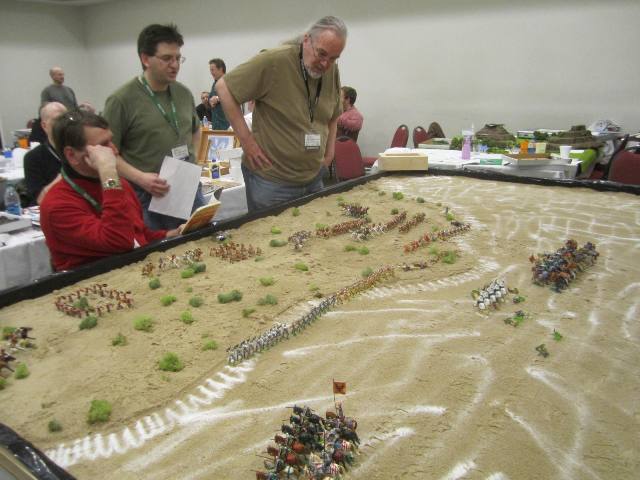
In those days players had few expectations about rules systems, GM style, genre, content and so on. Mostly the game (circa 1974) was played as a War Game with supplemental fantasy rules. There were, most of the time but not always, miniatures involved and a game board that was constructed on a large table and held the kind of terrain that one might see in a museum diorama. Something like the image on the right might have been considered common in those days.

The point is that the game was at first something that appealed to a very small number of people who were interested in War Games, and in particular Miniatures based War Games. This is what we might think of as the Gygaxian style.

And then, almost instantly, there was a divergence.  David Arneson, the co-collaborator on D&D with Gygax, introduced and championed the idea, basically, of D&D as a 'Story Game'. I don't think he called it that, but the essential idea was there. The RPG was a kind of semi-perfect system for telling interactive stories that involved characters and setting. For this style of game, which we might call the Arneson style, the story became equal to, or more important than the game mechanics. Yes, the mechanics were still important as no one wanted to play "Let's pretend" with the RPGs. So rules were necessary, but the most important thing in the Arneson style game is that the story-world, and the characters in it, be interesting. Interesting enough to bring the players into a sense of what was called immersion.

My first experience with D&D of any kind was in Eric Tannen's world in 1978. He played an Arneson style game, and frankly he had made up his own rules at that time, as did every other GM in our town, and I didn't know what his rules actually were exactly. So story, from my point of view as a player was paramount. I was intrigued by Eric's world. I was intrigued by my ability to play characters that go and (attempt to) do anything. It was a fascinating experience, and the combination of a rich and interesting world and what we now call "Player Agency" (at the time the only meaning of that phrase could be construed as "the player can decide what their character may attempt to do") kept me coming back for more. Within a month of my first game I was already working on the Elthos Rules system. It was the habit, if not the rule, among our GMs to create their own rules. We were a strictly "Anti-Gygaxian" crew, and while we could use D&D e1 as a basis for our systems, every GM created their own. Sometimes from scratch. Sometimes as a derivation of D&D e1. Either way, the players rarely knew what the GM's rules actually were.

Yes, I'm getting around to my points. But this historical context is necessary when trying to dig into the root causes of "The Sad GM". Bare with me please.

As I was saying, we all had our own rules, and player expectations were kept to a bare minimum. The only expectation players might have in those days was to have fun being immersed (hopefully) in a GM's amazing world. For this, of course, GM's had to have amazing worlds. That is not as easy as it sounds. And this was were the first player bust ups came in. Some GMs had worlds that were boring. You'd get there, roll a character, and it felt like nothing was really there in the world. Some stock generic NPCs would get trotted out to "provide information", but had no individual personalities (or they all had the same one). The World had no discernible history. There might be a town and a dungeon, but who knew why or what for? There was nothing unique in those worlds. Perhaps just rehashes of scenes from popular fantasy books or movies. So our first encounter with broken expectations came early with Arneson style games. Some GMs were apparently not quite cut out for the job. Not enough imagination.

That would have been enough to create some problems for the nascent hobby, but it didn't stop there. We then suffered wave after wave of New Rules from TSR, and other companies. The idea of one game for 50 years was kind of broken at that point. And this time it was the GM expectation of continuity that was broken. At least from my point of view looking at the thing from afar it seemed that way to me. In fact it was our prescient decision to create our own rules systems that allowed most of us 1st generation GMs to avoid that particular catastrophe. I recall my conversation with Eric in 1978 about the future of RPGs and we agreed that creating our own rules was the ideal solution to several problems. 1) we wouldn't have to suffer "rules lawyers" (already prevalent in those early days), 2) we could "fix" the problems we found with the original rules to our heart's content, and 3) we would not have to suffer dealing with major rules changes that could destroy our world's historical context every time TSR decided they wanted to make more money with a new Rules edition. Made sense to me, and so I had my own rules, and wasn't effected by D&D e2 (AD&D) and beyond. I happily played Elthos and so my GM expectations were never quite dashed by the introduction of new editions. I heard the screams and groans from a distance, huddled in my cozy hobbit hole and played on.

However, unknown to me, the world outside was changing. A lot. The biggest change, I think, was the introduction of the Independent Press Revolution that came as a result of technological advances in the printing industry. All of a sudden anyone could publish their rules as books and sell them without too great an up front cost (in dollars, not time). When the Revolution began it seems to have centered around The Forge, which purported to be, if I have this right, a kind of RPG philosophic center that encouraged RPG Publishers to do new things with the game so that they could distinguish their products from those of other publishers, and in particular Wizards of the Coast (which by this time I believe had bought out TSR, which went down in flaming ruins due to internal mismanagement and multiple errors of judgement along the way).

Now what happened next was a shift, a major shift, in player expectations. Again, remember I was in my hobbit hole with Elthos at this time, and had very little interest in following what was going on in the industry at this point, so my viewpoint is personal and partial, but this is what I think happened...

This shift was fostered by the marketing messages that were coming out of the IPR, and principally, afaik, from the major IPR Publishers of the "new style" of RPG. The Revolution was posed as one against the old traditional Gygaxian style game, and championed the Arneson style. It experimented a great deal with rules configurations, and seemed to focus on the idea (right or wrong who knows) that the rules should support the genre of play. There's probably a lot of reasons why this concept was fostered in the IPR, and maybe the main reason was that it created a kind of organizational coherency to the IPR. So if you came to an IPR workshop at a local convention they had a focus and could ask you "the Power 19" questions that would reveal whether or not you successfully embodied their principals of game design.

Across the divide over yonder there were some woeful reactions to the "Indie Revolution" as traditional GMs got pelted by accusations of "Tyranny" from a new breed of converted players. These players now expected an expanded set of Player Agency capabilities, such as co-creating the World. This is probably the one that sticks in the craw of most traditional GMs the most. And there's good reason for it, but that's a topic for a different post.

The upshot is that many firestorms were started between the two communities of RPGers. On the one side we had the 'Ancien Regime' of traditionalist GMs who preferred to keep things the way they were, and on the other side the 'Revolutionaries' who seemed to style themselves as something of an insurgent guerrilla army intent on overturning the traditionalists at any cost with a new breed of games. The rhetoric on both sides got quite heated. From my point of view, by the time I poked my head out from my hole to take a peek around the war was in full flaming glory. Since I had spent most of my time tinkering with a computer application to run my rules system and allow GMs to share their worlds with each other, I'd spent precious little time looking at anyone else's rules. So I was pretty clueless about the difference between the IPR and what later became, if I have this right, the OSR (Old School Renaissance). Once I did step outside my door and made my first foray into the greater world of RPGs by attending a local gaming convention around 2010, I was immediately blasted as "a spy" by the OSR when I mentioned on theRPGSite my recent experience with Luke Crane's Burning Wheel at the convention. I was denounced, and flogged, by the people of the OSR, and it took quite a bit of effort to explain that I wasn't on either side of the war - strictly an independent soul working on Elthos, and just curious about what was going on out there. It was fascinating.

Now you'd think that this might have given me a bad attitude about the OSR. Not really. At that point actually, I had a previous experience with the "Indie Revolution" that had already put me on guard to the marketing invectives streaming out of that community and their destructive power. I had been running very happily and successfully a nice little Yahoo Group for the Literary RPG Society, and it' had been going strong since about 2006 and we had a lot of great posts and local meetings and all was going well. Our goal was to collaborate on ways for GMs to enhance the story aspect of their Worlds through a variety of techniques, and it was mostly a discussion and brainstorming society. It was great. Until one day an Indie Revolution 'Stealth Evangelist' arrived. He single handedly turned every thread in the forum, every single one, into an argument about why you should stop playing traditional style RPGs and convert over to the Young Hip & New Indie Revolution style. It got to the point where posters would write me emails on the side saying they no longer can tolerate it and were leaving the group because of this person. I tried my best to get this person to cool it, and he would for a few days, but then come back again with the same thread-jacking and in the end everyone stopped posting completely. I tried about a year later to post again to the group to hope for a revival, but within minutes of my post our old Indie Revolution friend immediately chimed in with - yes - another thread-jacking. And so my once beloved group is in ruins on Yahoo Groups. You can find it, and see for yourself how things went down, so long as Yahoo still exists, by going here and taking a look:

https://groups.yahoo.com/neo/groups/lrpgsw/info

That experience made me a Sad GM. *sob* ... But I moved on, and got over it. I decided life in my hobbit hole was a nicer place than I expected, and pretty much retreated back to work on Elthos and the Mythos Machine while the war rages overhead. So for the most part I've pretty much tried to stay out of the fray. What's the point of it? I don't disagree that there's a good number of Indie Revolution games that I might like, but the marketing invective and the stealth evangelism that came out of the Revolution were from my point of view totally destructive. I lost all interest in so-called "Indie Revolution" games after that. Whether they were good or not, I simply didn't want to get near them. I suppose ti's a natural enough reaction. My attitude now is that they may be fine games, and I'm not against them per se as games, but I will growl under my breath if I hear phrases like "BadWrongFun" or see someone doing ye old stealth evangelism around me.  It is these things, and their deleterious effect on player expectations that has made me, to whatever degree I might be, a Sad GM. It just grates on my nerves, that's all. I hope people will understand and not be too offended at my being too offended.

Ok, to wrap this up I will conclude by saying that I feel that a lot of what has caused the problems in the RPG community that Jens D is referring to, and the consequent Sad GM experience, have to do with the innate nature of the hobby as it evolved, and the history of negativity that is a product of changing and expanding expectations of players and GMs over time. I think it boils down to this - at some point the domain of expectations based on an ever expanding multiplicity of options becomes so great that it fractures into a myriad of expectation-shards. Some players want this piece of that, and that piece of this, and some GMs want this much of that system, and that much of this system - every RPGer for themselves, and damn the torpedoes! The loss of coherency in the World of RPGs has created a good deal of difficulty for GMs. And the reason for that is as Jens D suggests in his post - GMs put in a great deal of effort into their worlds based on some system. When encountering players with a huge diversity of expectations as to game style, modalities and rules, it becomes a serious problem for GMs. And that is likely to make GMs Sad once in a while. I can't say I disagree with that. Fortunately for me, I have my own system, and my players happen to like it. So I'm pretty safe in my cozy little hobbit hole. So for the most part I haven't had to deal with these problems as a GM. When my players show up I tell them this is the Elthos RPG, here's the rules book, and leave your previous expectations at the door, thank you. Thank goodness.

And that is where I think we're at in terms of "root causes". Frankly this is a light treatment, and a seriously biased one, and there's a good chance my viewpoint is factually flawed due to my limited exposure to the Great RPG War as it was waged. But still, I think I have it more or less right, and I could go on and probably write an entire book on this topic and still not exhaust all that could be said on it by all sides involved. At any rate, that's my understanding to date, and I hope it helps to put things into perspective, at least somewhat. At least from my point of view this is what the "root causes" seem to be. If you disagree with my viewpoint, have anything to add, or correct, please feel free. My attitudes are rarely set in stone, and I'm always curious what others think.

Are there any solutions to the problems Jens D has raised in his post? We will have to wait to see. He will be posting on the topic again in his promised Parts II and III. I look forward to reading them as well. I have a few ideas of my own, but will refrain from commenting on that until after I read what Jens D has to say. Looking forward to it.