On the Joys & Challenges of developing the Elthos RPG & Mythos Machine, and other sundry RPG matters.
Sunday, April 17, 2011
The Cataclysms of Elthos
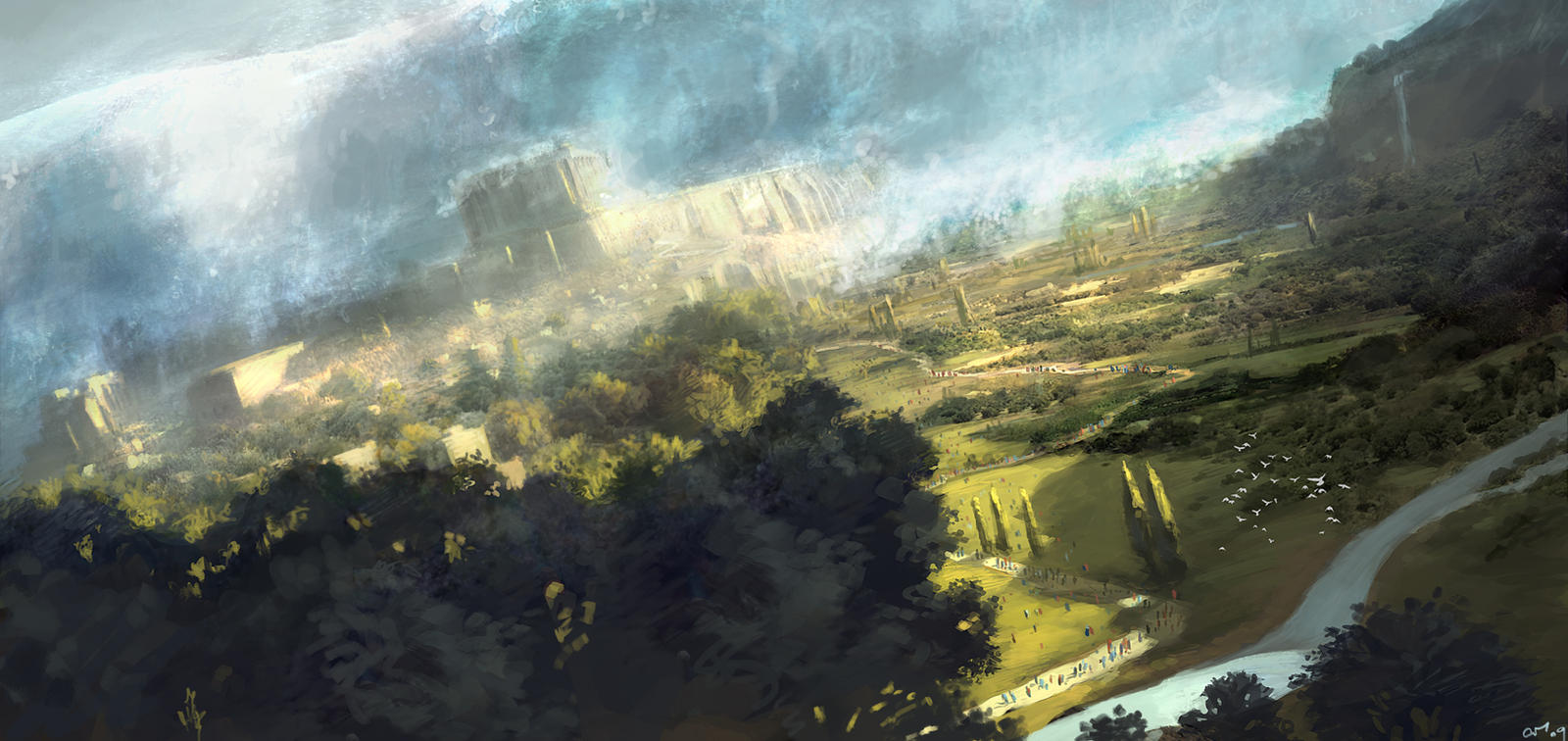
As a World Weaver I've spent a good deal of time considering and planning for the Great Cataclysms of Elthos. They lay latent in the World's Back Story, waiting patiently for the right time and conditions for them to be set in motion. Elthos has 12 Major Cataclysms, one for each of the Major Celestial Powers. None of them have thus far played out in the game, primarily because I am playing my world in a very down-to-the-ground local adventure mode. That means I tend to play low level campaigns, as opposed to Epic, often starting Characters out as 1st Level village kids ranging in age from 10 to 14, with chores and ordinary village lives, who then get caught up in the inner-world adventures of the Fey somehow or other. Thus my adventurers rarely catch wind of anything even remotely related to the 12 Major Cataclysms. They simply do not come up, and nothing is so much as rumored about them. It is, from my Player's point of view, as if they do not exist.
But the Cataclysms, in the hands of each of the Celestial Powers of Elthos, do exist, albeit slumbering uneasily in the depths of the Back Story... only awaiting the Player Characters to fall upon the right Relic at the right time, for Gates of Destiny to open, for the releasing one of the Major Cataclysms, or even potentially opening the Terrible Gate of Doom to the Ultimate Cataclysm... the End of Ages, or the End-War of the Elkron, my World's version of the Apocalypse.
Just to explain a bit about the Ultimate Cataclysm... The End-War of the Elkron is the final battle of supremacy for the the Rule of the Elthos Universe. The Elkron are the unseen but widely worshipped Celestial Powers who have interacted little with the World of Elthos since the Dawn Age, but have observed much of the affairs of the races they created. The End-War occurs when the entire Universe of Elthos must endure the final battle of the Elkron, as all their Seeds of Destiny bear fruit and the Cosmic Stratagems of the Elkron are finally revealed and all Fates and Destinies are played out. As it must be, the World of Elthos will someday be torn asunder by the Elkron as it must always and eventually be returned into it's primordial state of existence. The Victors of the End-War become the Ruling Elkron in the next Universe, as the Elkron are reborn for the next Cycle of Existence, as will ever be so long as the Universe of Elthos is breathing.
There are, of course, much lesser Cataclysms of the Elkron that are not nearly as dire as the End-War, and much closer to be played in-game than the End of Ages Campaign. I really do not expect any of the Cataclysms to be played out any time, soon, however, but that said, the 12 Major Cataclysms, and scores of Minor Cataclysms that are tied to the various Seeds of Destiny of the Elkron stand a much higher chance of being played than the End-War.
These Minor Cataclysms could be triggered relatively easily by Player Characters who might choose to follow the paths of the Elkron in order to achieve one of the Greater Quests (aka Seeds of Destiny) strewn around the World. But then again, I honestly don't really expect the Players to stumble into any of the Minor Cataclysms either. I really created them in order to fill out the Grand Picture of the Elthos World, at the macro-Cosmic level, just so that my World has that aspect in place, even if it remains entirely latent to the actual in-Game Campaigns. But of course, since they are there, you really never know... some Player Character might actually trigger any of them, if they happen to stumble upon them and do just the wrong things at just the wrong times. The Elkron who created the particular Seed of Destiny won't object, believe me. They are looking forward to it with a relentless and voracious intent.
As an example, which I won't describe in too much detail just now for obvious reasons, I can offer a certain something hidden deep within the Temple of the Sun in the Kingdom of Palamir. In that temple there is a dreadful chest, hidden an bolted to the ground at the center of a secret hall deep beneath the temple, that is made of solid gold and inscribed with great glyphs, and inscribed with dire warnings. The Priests of that Temple are taught to preserve it, and never to open it until the time that the Elkron of the Sun himself shall ordain it. If anyone, such as a Player Character, should ever manage to battle his way through violence to the chest, or worm his way through deception, and then happens to open the unlocked chest of gold, they will learn a great deal about what the Elkron are like. It will signal the opening of one of the Gates of Destiny, and undoubtedly, a Minor Cataclysm will be set into motion, and one of the Seeds of Destiny may be fulfilled. Such are the ways of the Elkron. It should be considered that the Elkron did not create the races of the world so that they could dote on them and pamper them and build civilizations for the fun of it - but rather as tools to be expended for the purposes of Universal Domination and Ultimate Victory.
Perhaps one day when the time is right I will begin a Campaign at the Epic Level of Elthos known as 'The End of Ages'... and in that Campaign the Player Characters may very well find out just how Great, and Mighty and Terrible the Elkron really are, and just how little humanity and it's petty conflicts really matter in the great scheme of things. Great, Mighty and Terrible indeed.
Friday, April 01, 2011
RPG Carnival: Cartography
Cartography
If a picture is worth a thousand words, I suggest a map is worth ten thousand words because maps put things into context. I do a lot of maps for my world. In fact I do a lot of Types of maps for my world. What do I mean? Well I not only map geography, but I also map plotlines, and story elements. So I have three kinds of maps, Geographic, Story Plot, and Elements maps.
As a general rule I try to keep things simple, and so I try to use reasonably simple tools. Over the years I’ve evolved a few strategies for creating my maps. That said, there are cartography tools out there that do a spectacular job creating maps of different kinds with different styles. I simply don’t use them. I prefer my own homebrew style, for no particularly good reason, other than I like the way my maps turn out.
For each of the three types of maps the first thing to understand is – what is the purpose of the map? I will go through each of the three and offer my thoughts, and methodologies for creating them.
My Tool Kit
I’ve tried a number of mapping tools over the years. Some online mapping tools are very good for certain kinds of maps. However, in the end, I found that using a simple set of tools is my preference.
Outdoor Maps: Pen and Paper – I prefer magic markers, and in particular sharpie pens with the thick tip. After I finish coloring and polishing in the software tools an outdoor map looks like this:
Indoor Maps: I have experimented with using Excel for making Dungeon Levels. I reduce the size of each cell to a square. I set the color of all cells to dark gray. Then I set the grid lines to show using the border tool. Then I “paint” corridors using the cell color format of white by selecting an area (can be one line of cells, or a block of cells) and using the format background color White. I number the rooms and use letter codes to indicate various things about the room, such as “s” for secret door, “d” for door, etc. I also figured out a way to add icons for stairs and such. The result is a dungeon map that looks like this:
Digital Camera – I photograph my pen and paper map, and put the file onto my computer where I can enhance it with the following tools:
Microsoft Paint – a very simple program that does certain simple things very nicely, such as drawing straight lines, boxes and circles that you can color, and provides several fill options that can be useful.
Google Picasa (optional) – for finishing touches this is a great piece of software. I usually like to do simple things like colorize the image, put a blur on the edges, or a soft glow, depending on the effect I want for the map image. I also like Picasa for adding Text to an image as it provides an easy to use resize and orientation tool. I don’t usually use this tool very much, but when I want an image to have a polished look, it’s free to install, and simple to use. For 99% of what I do in terms of polishing, it’s great.
Microsoft Image Composer (optional) – ok you can be forgiven if you never heard of this tool. It came with the 1997 installation of Visual Interdev (an early development tool for web applications). That said, it is much like Photoshop (which is very expensive for my tastes). However, there is also GIMP, which also has the same kinds of functionality as Photoshop and happens to be open source and free. Anyway, what I use this tool for is either Airbrush painting to put shadows or hightlights into my images, or freehand color them. I also may use (lightly) the Art Filters which allow me to transform an image into a more impressionistic version of the original, using one of a variety of filters such as Watercolor, Sumie, Dark Strokes, Charcoal, etc. Again, I use this tool very sparingly just to provide finishing touches.
That’s it for the tools. Again, most of my work is done with pen and paper to start. I find this gives me a nice way to make organic feeling maps.
Geographic Maps
These maps are intended to show a geographic area, obviously. I usually like to include natural terrain as well as roads, towns, and hot spots (where important things are happening, or may happen). But the main question to be answered for the geography map is – what in this area of the World is important for the Gamesmaster to remember? So I try to make my maps expose Avenues of travel (with consideration of creatures that may travel by various means), Barriers to travel, Focal Points of activity (towns, cities, temples, etc), and Strategic Points (lookouts, passes, choke points, etc). But mostly, the map is usually used by me simply as a reminder as to what the area looks like:
One thing I don’t do is try to make the map too detailed, or too accurate (ie – I like to bake in flexibility so that when Gamesmastering I can shift things around a bit according to need). Remember, we’re usually dealing with Fantasy worlds here, so geographies do not necessarily need to be set in stone. Hehe. Punnish. It’s good to keep in mind that Geography maps in the game are not going to be used the way Geography maps in the real world are used. The players will not be physically travelling using the map (although their Characters may very well be), so there is no need to make them absolutely accurate. Fudging in RPGs is a tried and true methodology for Gamesmasters because you always want to maintain a certain amount of flexibility so your story does not run aground against The Facts. That has been known to happen (ahem). So I keep my maps a little bit vague. Rough sketch is fine.
Story Plot Maps
The purpose of these is to create a story focused memory map that shows an overview of the various characters, places, and things that have occurred, along with any symbolic references I might want to add to remind me of important aspects of the story. It can represent either the story that already happened, or may happen in the future. Again, the purpose is to prove me with a simple, easy to use visual that reminds me what is going on in the Campaign, or inspires me with creative sparks to help with the improvisational aspects of Gamesmastering. Here is an example of one of my Story Plot Maps:
Elements Maps
Last but not least, this type of map is useful for tracking characters and places in terms of who is together with whom and where. I use a wonderful little online tool at https://bubbl.us/. This wonderful tool makes it handy for me to create what are known as Mind Maps, but I use it specifically for my Game Elements. Again, a picture being worth a thousand words, here is what one looks like:
It’s a fabulous little tool! Love it.
And so those are the different kinds of maps I usually create for my world, and how I create them. I hope it helps to inspire other Gamesmasters with ideas and helpful methodologies! Happy trails!
Update (May 2, 2011):
The April 2011 RPG Carnival was kindly hosted by 'A Character for Every Game' Blog here: RPG Carnival - Cartography - April 2011. Elthos RPG is honored to be mentioned therein! Thank you for the kind words! In case you don't know, RPG Carnival works very simply. The author of a topic posts it to the group of interested RPG Bloggers and we all write blogs on the topic. When we post the blog we then go to the host's monthly topic post and comment that we added a post to our blog on the topic. At the end of the month they are tallied up in a summary post. It's awesome! Thanks very much to the hosts!!
If a picture is worth a thousand words, I suggest a map is worth ten thousand words because maps put things into context. I do a lot of maps for my world. In fact I do a lot of Types of maps for my world. What do I mean? Well I not only map geography, but I also map plotlines, and story elements. So I have three kinds of maps, Geographic, Story Plot, and Elements maps.
As a general rule I try to keep things simple, and so I try to use reasonably simple tools. Over the years I’ve evolved a few strategies for creating my maps. That said, there are cartography tools out there that do a spectacular job creating maps of different kinds with different styles. I simply don’t use them. I prefer my own homebrew style, for no particularly good reason, other than I like the way my maps turn out.
For each of the three types of maps the first thing to understand is – what is the purpose of the map? I will go through each of the three and offer my thoughts, and methodologies for creating them.
My Tool Kit
I’ve tried a number of mapping tools over the years. Some online mapping tools are very good for certain kinds of maps. However, in the end, I found that using a simple set of tools is my preference.
Outdoor Maps: Pen and Paper – I prefer magic markers, and in particular sharpie pens with the thick tip. After I finish coloring and polishing in the software tools an outdoor map looks like this:
Indoor Maps: I have experimented with using Excel for making Dungeon Levels. I reduce the size of each cell to a square. I set the color of all cells to dark gray. Then I set the grid lines to show using the border tool. Then I “paint” corridors using the cell color format of white by selecting an area (can be one line of cells, or a block of cells) and using the format background color White. I number the rooms and use letter codes to indicate various things about the room, such as “s” for secret door, “d” for door, etc. I also figured out a way to add icons for stairs and such. The result is a dungeon map that looks like this:
Digital Camera – I photograph my pen and paper map, and put the file onto my computer where I can enhance it with the following tools:
Microsoft Paint – a very simple program that does certain simple things very nicely, such as drawing straight lines, boxes and circles that you can color, and provides several fill options that can be useful.
Google Picasa (optional) – for finishing touches this is a great piece of software. I usually like to do simple things like colorize the image, put a blur on the edges, or a soft glow, depending on the effect I want for the map image. I also like Picasa for adding Text to an image as it provides an easy to use resize and orientation tool. I don’t usually use this tool very much, but when I want an image to have a polished look, it’s free to install, and simple to use. For 99% of what I do in terms of polishing, it’s great.
Microsoft Image Composer (optional) – ok you can be forgiven if you never heard of this tool. It came with the 1997 installation of Visual Interdev (an early development tool for web applications). That said, it is much like Photoshop (which is very expensive for my tastes). However, there is also GIMP, which also has the same kinds of functionality as Photoshop and happens to be open source and free. Anyway, what I use this tool for is either Airbrush painting to put shadows or hightlights into my images, or freehand color them. I also may use (lightly) the Art Filters which allow me to transform an image into a more impressionistic version of the original, using one of a variety of filters such as Watercolor, Sumie, Dark Strokes, Charcoal, etc. Again, I use this tool very sparingly just to provide finishing touches.
That’s it for the tools. Again, most of my work is done with pen and paper to start. I find this gives me a nice way to make organic feeling maps.
Geographic Maps
These maps are intended to show a geographic area, obviously. I usually like to include natural terrain as well as roads, towns, and hot spots (where important things are happening, or may happen). But the main question to be answered for the geography map is – what in this area of the World is important for the Gamesmaster to remember? So I try to make my maps expose Avenues of travel (with consideration of creatures that may travel by various means), Barriers to travel, Focal Points of activity (towns, cities, temples, etc), and Strategic Points (lookouts, passes, choke points, etc). But mostly, the map is usually used by me simply as a reminder as to what the area looks like:
One thing I don’t do is try to make the map too detailed, or too accurate (ie – I like to bake in flexibility so that when Gamesmastering I can shift things around a bit according to need). Remember, we’re usually dealing with Fantasy worlds here, so geographies do not necessarily need to be set in stone. Hehe. Punnish. It’s good to keep in mind that Geography maps in the game are not going to be used the way Geography maps in the real world are used. The players will not be physically travelling using the map (although their Characters may very well be), so there is no need to make them absolutely accurate. Fudging in RPGs is a tried and true methodology for Gamesmasters because you always want to maintain a certain amount of flexibility so your story does not run aground against The Facts. That has been known to happen (ahem). So I keep my maps a little bit vague. Rough sketch is fine.
Story Plot Maps
The purpose of these is to create a story focused memory map that shows an overview of the various characters, places, and things that have occurred, along with any symbolic references I might want to add to remind me of important aspects of the story. It can represent either the story that already happened, or may happen in the future. Again, the purpose is to prove me with a simple, easy to use visual that reminds me what is going on in the Campaign, or inspires me with creative sparks to help with the improvisational aspects of Gamesmastering. Here is an example of one of my Story Plot Maps:
Elements Maps
Last but not least, this type of map is useful for tracking characters and places in terms of who is together with whom and where. I use a wonderful little online tool at https://bubbl.us/. This wonderful tool makes it handy for me to create what are known as Mind Maps, but I use it specifically for my Game Elements. Again, a picture being worth a thousand words, here is what one looks like:
It’s a fabulous little tool! Love it.
And so those are the different kinds of maps I usually create for my world, and how I create them. I hope it helps to inspire other Gamesmasters with ideas and helpful methodologies! Happy trails!
Update (May 2, 2011):
Thursday, March 31, 2011
Ethos ODS Tarot Deck !
It is very gratifying as a game designer to finally have a tangible and beautiful manifestation of their work. I am very grateful to my artist, Jason Moser, who took my written descriptions for each card and turned them into an exquisite deck of Elthosian Tarot Cards. It's fabulous. At the moment we have only printed the major arcana, which are 24 cards, and the only ones actually needed for the Elthos Cosmological system. Nevertheless the minor arcana are already finished, but no printed into cards at this point. This was a test batch to see how the Major Arcana cards look when printed. I just received 10 decks in the mail. I am absolutely delighted with the results!
Here is a sample of the six of the cards starting with the back face...
I could not be happier! Thank you so much Jason! Two decks are heading your way pronto!
Sunday, March 06, 2011
Elthos ODS Tarot Deck
It's an exciting development and I'm looking forward to seeing the results of the test print. Here you can see The Emperor Card. You may notice the circle at the bottom, which demonstrates the card's astrological alignment, and key correspondences. The images in the card reflect additional correspondences as well. The entire deck was designed to give the Gamesmaster an easy visual reference to a correspondence system that can help to keep the back story of the game coherent over time. It does a few other things to help with World Weaving aspects of the game as well, but more on that another time.
The Cards are designed by yours truly, and the artwork was done by Jason Moser of Ellium Fame at Asylum.Net. Jason is a wonderful artist, and exceedingly professional in his dealings with me. It was delightful to work with him on the Tarot Deck, and I look forward to working with him again on other aspects of the Elthos Project.
Thursday, February 10, 2011
RPG Carnival - World Building
I've always felt that World Building is one of the most fun and challenging aspects of Gamesmastering. When I saw RPG Carnival has set this month's topic to World Building I thought I would give it a shot.
How do you get the worlds you use for your game?
I do a lot of reading. Mostly classical literature, the older the better. I use those stories to a large degree to shape my world. Places, Characters, Themes. All of these can be found in abundance in the works of antiquity. I prefer those works, possibly, because I find the ancients managed to dig deeply into human psychology, and many of their storys have an internal symbolic coherency I admire. I try to emulate those aspects in my world.
I also, in addition, watch the news to look for events that I think would play out as interesting plots in my campaigns. They can be very broad geo-political events, such as what is going on now in the Middle East, or they can be very minor local events such as the chaos produced by a water main break. I look for any aspect that would be interesting for my world, such as Place, Character, Items, or Plotline.
Lastly, perhaps, I read a lot of history books, and science magazines. History is great for understanding the Big Picture of Politics, Economics, and Sociology. All of that helps in shaping my world and my campaigns. I also like to read science magazines for interesting new concepts that I may be able to apply. A lot of times I may take a new science idea, and convert it into a magic idea within my world.
Do you create your own or use a published world?
I definitely create my own world, but it is based on what I find in literature and life's explorations. I tend to go with "There is nothing new under the sun." in regards to story telling. But how we mix and play with the elements of story handed down to us has infiinte potential. So I never get bored by it, and my world feels unique to me, even though many elements are drawn from prior sources.
If you create your own, where did you start?
I usually start with a map. I then look at the terrain and assign races. Then I look at the map's terrain and determine where the Avenues and Boundarys are located, and figure out which races control which routes, and for what purposes. I then look for Places of Strategic Interest. These will get controlled by one or more races. Now I am ready to sketch out a rough draft of the history of the land. I establish the major towns and citys, dynasties and kingdoms, and so on. I draw up some historic conflicts, and usually stop there. It is good enough. I don't like to start my world with too much detail. I often let the details emerge during play. It helps me to stay flexible. Another thing I do is to create historic events, but not necessarily assign them a specific date or location. Such as "The War of the Insects" was a concept that had no place or location until it came up in play. And then it did.
What do you like best about building your own settings?
Two things. One I like the suprise that the players experience as they explore the world, not having read about it in someone elses Campaign Setting book. And of course I love to create the world, as through that process I feel I am authoring something interesting, and at the same time learning more about our own real world.
What suggestions and resources do you have for teaching others how to build worlds of the their own?
I recommend reading a lot of classical litereature, and history. I also recommend living a lot of life. Try to gain interesting experiences along the way that you can then add to the art of your world. Become an excellent observer of life.
What are the pros and cons of building your own world?
The pros are that you have created your own and it's yours and you can do with it what you like and suprise your players and enjoy the fruits of your labors. The cons are that it is a lot of work and to do it well requires effort and imagination in abundance. Many people simply do not have the time for it.
Where do you get the inspiration for your worlds?
Book Title, Author
Tarzan Series, Edgar Rice Boroughs
Bhagavad Gita, Unknown
Tao te Ching, Lao Tzu
The Art of War, Sun Tzu
The Book of Five Rings, Musashi
The I Ching; The Book of Chnages, King Wen (Trans. Brian Browne Walker)
The Republic, Plato
The Laws, Plato
The Symposium, Plato
The Meno, Plato
The Crito, Plato
Lensman Series, E. Smith
Euthyphro, Plato
Apology, Plato
Phaedo, Plato
The Politics, Aristotle
Metaphysics, Aristotle
Nicomachean Ethics, Aristotle
The New Atlantis, Francis Bacon
The Prince, Machiavelli
On History, Kant
Thus Spoke Zarathustra, Nietzsche
A Wrinkle in Time Series, Madeleine L'Engle
Selected Essays, Emerson (On Nature)
The Glass Bead Game, Herman Hess
History of Political Philosophy, Leo Strauss & Joseph Cropsey
Thoughts on Machiavelli, Leo Strauss
Introduction to the Reading of Hegel; Lectures on the Phenomenology of Spirit, Alexandre Kojeve
Love of Glory and the Common Good; Aspects of the Political Thought of Thucydides, Michael Palmer
Warfare in the Classical World, John Warry
A field Guild to the LIttle People, Nancy Arrowsmith
The Encyclopedia of Superstitions, E & M Radford
The World Guide to Gnomes Faries Elves and other Little People, Thomas Keightley
The Dragon and the Unicorn Series, A. A. Attanasio
Dandelion Wine, Ray Bradbury
One Hundred Years of Solitude, Gabriel Garcia-Marquez
The Book of Splendor (The Zohar), various attributions
Ecclesiastes, attributed to King Solomon
Book of Job, Unknown
Ishmael, Dan Quinn
The Story of B, Dan Quinn
A Confession and other religious writings, Leo Tolstoy
The Satanic Verses, Salman Rushdie
Encyclopedia of Things that Never Were, Michael Page
Sabriel Series, Garth Nix
World Mythology, Roy Willis (Ed.)
The Way of Passion, Andrew Harvey
The Demolished Man, Alfred Bester
Being Peace, Thich Nhat Hanh
The Power of Myth, Bill Moyers
Gods & Myths of the Viking Age, H.R. Ellis Davidson
Fire in the Head, Tom Cowan
Myths and Symbols in Pagan Europe, H. R. Ellis Davidson
The Place of the Lion, Charles Williams
Classic Celtic Fairy Tales, John Matthews
The High King Series, Lloyd Alexander
Robin's Laws of Good Gamemastering , Robin Law
The Grail Trilogy (Archers Tale, Harlequin, Vagabond), Bernard Cornwell
Arthurian Legends (Winter King, Enemy of Good, Exalibur), Bernard Cornwell
The Saxon Stories (The Last Kingdom, The Pale Horseman, The Lords of the North, Sword Song), Benard Cornwell
Treasure Island, Robert Louis Stevenson
Sharpe Series, Benard Cornwell
Hornblower Series, C.S.S. Forester
The Gods of Pegana, Lord Dunsany
Time and the Gods, Lord Dunsany
Myths and Symbols in Pagan Europe, H. R. Ellis Davidson
Mossflower, Brian Jacques
Perdido Street Station, China Mieville
Arthurian Romances, Chretien de Troyes
The Faerie Queen, Edmund Spenser
Sir Gwaine and the Green Knight, Unknown
Tales of King Arther, Sir Thomas Malory
Tristan and Isolde, Strassburg
The Song of Roland, Unknown
Idylls of the King, Alfred Lord Tennyson
The Quest of the Holy Grail, Walter Map [Mattarasso]
The Death of King Arthur, Walter Map
The Pearl, unknown
The Lady of the Lake, Sir Walter Scott
The Hobbit, JR Tolkien
The Laxdaela Saga, Unkonwn
Parzival, W.V. Eschenbach
Willehalm, W.V. Eschenbach
The Nibilungenlied, Unknown
The Mabinogion, Unknown
Beowulf, Unknown
Fairy Tales, Hans Christian Anderson
Folk Tales, The Brothers Grim
Irish Fairy Tales, Jeremiah Curtin
The Complete Fairy Tales, George MacDonald
Lord of the Rings, JR Tolkien
The Yellow Fairy Tale Book, Andrew Lang
The World's Great Folktales, James Forster (Editor)
Danish Fairy Tales, Inge Hack
Castle of Oranto, Horace Walpole
Dracula, Bram Stoker
Frankenstien, Mary Shelly
Vathek, William Beckford
The Screwtape Letters, C. S. Lewis
Perlandria Series, C. S. Lewis
Poetry by Edgar Allan Poe, Edgar Allan Poe
The Silmarillion, JR Tolkien
Stories by Lovecraft, Lovecraft
The Norse Myths, Kevin Crossley-Holland
Saga of the Volsungs, Jesse L. Byock
Egil's Saga, Paul Edwards
Prose Edda, Jean I. Young
Illiad, Homer
Odyssey, Homer
The Hermetica; The Lost Wisdom of the Pharohs, Timothy Freke & Peter Candy
Mythologies of the Ancient World, S. Kramer
Myths from Mesopotamia, Stephanie Dalley
Farmer Giles of Ham, JR Tolkien
Poems of Heaven and Hell from Ancient Meopotamia, N.K. Sandars
Sumerian Mythology, S. Kramer
The Sumerians, S. Kramer
Inanna; Queen of Heaven and Earth, S. Kramer
The Aeneid, Virgil
La Vita Nova, Dante
Lysistrata, Aristophanes
The Clouds, Aristophanes
The Wasps, Aristophanes
The Poet and the Woman, Aristophanes
The Narnia Chronicles, CS Lewis
The Frogs, Aristophanes
Metamorphosis, Ovid
Fables of Aesop, Aesop
The Works of Sir Walter Scott, Sir Walter Scott
The Holy Bible [King James], The Almighty Creator
Paradise Lost, Milton
Divine Comedy, Dante
Piers the Ploughman, William Langland
Dark Night of the Soul, St. John of the Cross
The Ladder of Perfection, Walter Hilton
Conan Series, Robert Howard
The City of God, Augustine
The Fathers of the Church; Homilies on Leviticus, Origen
Confessions, Saint Augustine
Ecclesiastical History of the English People, Bede
The Guide for the Perplexed, Moses Maimonides
The Peloponnesian War, Thucydides
The Histories, Herodotus
Germanicus, Tacitus
Lives, Plutarch
The Age of Alexander, Plutarch
Solomon Kane Series, Robert Howard
The Early History of Rome, Livy
Rome and the Mediterranean, Livy
The War with Hannibal, Livy
The Rise of the Roman Empire, Polybius
The History of the Kings of Britain, Geoffrey of Monmouth
The Travels, Marco Polo
The Epic of Gilgamesh, Unknown
The Hermetica, Timothy Freke
Shrimad Bhagamatam (Volumes 1-14), Unknown
Dharmapada, Unknown
How do you get the worlds you use for your game?
I do a lot of reading. Mostly classical literature, the older the better. I use those stories to a large degree to shape my world. Places, Characters, Themes. All of these can be found in abundance in the works of antiquity. I prefer those works, possibly, because I find the ancients managed to dig deeply into human psychology, and many of their storys have an internal symbolic coherency I admire. I try to emulate those aspects in my world.
I also, in addition, watch the news to look for events that I think would play out as interesting plots in my campaigns. They can be very broad geo-political events, such as what is going on now in the Middle East, or they can be very minor local events such as the chaos produced by a water main break. I look for any aspect that would be interesting for my world, such as Place, Character, Items, or Plotline.
Lastly, perhaps, I read a lot of history books, and science magazines. History is great for understanding the Big Picture of Politics, Economics, and Sociology. All of that helps in shaping my world and my campaigns. I also like to read science magazines for interesting new concepts that I may be able to apply. A lot of times I may take a new science idea, and convert it into a magic idea within my world.
Do you create your own or use a published world?
I definitely create my own world, but it is based on what I find in literature and life's explorations. I tend to go with "There is nothing new under the sun." in regards to story telling. But how we mix and play with the elements of story handed down to us has infiinte potential. So I never get bored by it, and my world feels unique to me, even though many elements are drawn from prior sources.
If you create your own, where did you start?
I usually start with a map. I then look at the terrain and assign races. Then I look at the map's terrain and determine where the Avenues and Boundarys are located, and figure out which races control which routes, and for what purposes. I then look for Places of Strategic Interest. These will get controlled by one or more races. Now I am ready to sketch out a rough draft of the history of the land. I establish the major towns and citys, dynasties and kingdoms, and so on. I draw up some historic conflicts, and usually stop there. It is good enough. I don't like to start my world with too much detail. I often let the details emerge during play. It helps me to stay flexible. Another thing I do is to create historic events, but not necessarily assign them a specific date or location. Such as "The War of the Insects" was a concept that had no place or location until it came up in play. And then it did.
What do you like best about building your own settings?
Two things. One I like the suprise that the players experience as they explore the world, not having read about it in someone elses Campaign Setting book. And of course I love to create the world, as through that process I feel I am authoring something interesting, and at the same time learning more about our own real world.
What suggestions and resources do you have for teaching others how to build worlds of the their own?
I recommend reading a lot of classical litereature, and history. I also recommend living a lot of life. Try to gain interesting experiences along the way that you can then add to the art of your world. Become an excellent observer of life.
What are the pros and cons of building your own world?
The pros are that you have created your own and it's yours and you can do with it what you like and suprise your players and enjoy the fruits of your labors. The cons are that it is a lot of work and to do it well requires effort and imagination in abundance. Many people simply do not have the time for it.
Where do you get the inspiration for your worlds?
Book Title, Author
Tarzan Series, Edgar Rice Boroughs
Bhagavad Gita, Unknown
Tao te Ching, Lao Tzu
The Art of War, Sun Tzu
The Book of Five Rings, Musashi
The I Ching; The Book of Chnages, King Wen (Trans. Brian Browne Walker)
The Republic, Plato
The Laws, Plato
The Symposium, Plato
The Meno, Plato
The Crito, Plato
Lensman Series, E. Smith
Euthyphro, Plato
Apology, Plato
Phaedo, Plato
The Politics, Aristotle
Metaphysics, Aristotle
Nicomachean Ethics, Aristotle
The New Atlantis, Francis Bacon
The Prince, Machiavelli
On History, Kant
Thus Spoke Zarathustra, Nietzsche
A Wrinkle in Time Series, Madeleine L'Engle
Selected Essays, Emerson (On Nature)
The Glass Bead Game, Herman Hess
History of Political Philosophy, Leo Strauss & Joseph Cropsey
Thoughts on Machiavelli, Leo Strauss
Introduction to the Reading of Hegel; Lectures on the Phenomenology of Spirit, Alexandre Kojeve
Love of Glory and the Common Good; Aspects of the Political Thought of Thucydides, Michael Palmer
Warfare in the Classical World, John Warry
A field Guild to the LIttle People, Nancy Arrowsmith
The Encyclopedia of Superstitions, E & M Radford
The World Guide to Gnomes Faries Elves and other Little People, Thomas Keightley
The Dragon and the Unicorn Series, A. A. Attanasio
Dandelion Wine, Ray Bradbury
One Hundred Years of Solitude, Gabriel Garcia-Marquez
The Book of Splendor (The Zohar), various attributions
Ecclesiastes, attributed to King Solomon
Book of Job, Unknown
Ishmael, Dan Quinn
The Story of B, Dan Quinn
A Confession and other religious writings, Leo Tolstoy
The Satanic Verses, Salman Rushdie
Encyclopedia of Things that Never Were, Michael Page
Sabriel Series, Garth Nix
World Mythology, Roy Willis (Ed.)
The Way of Passion, Andrew Harvey
The Demolished Man, Alfred Bester
Being Peace, Thich Nhat Hanh
The Power of Myth, Bill Moyers
Gods & Myths of the Viking Age, H.R. Ellis Davidson
Fire in the Head, Tom Cowan
Myths and Symbols in Pagan Europe, H. R. Ellis Davidson
The Place of the Lion, Charles Williams
Classic Celtic Fairy Tales, John Matthews
The High King Series, Lloyd Alexander
Robin's Laws of Good Gamemastering , Robin Law
The Grail Trilogy (Archers Tale, Harlequin, Vagabond), Bernard Cornwell
Arthurian Legends (Winter King, Enemy of Good, Exalibur), Bernard Cornwell
The Saxon Stories (The Last Kingdom, The Pale Horseman, The Lords of the North, Sword Song), Benard Cornwell
Treasure Island, Robert Louis Stevenson
Sharpe Series, Benard Cornwell
Hornblower Series, C.S.S. Forester
The Gods of Pegana, Lord Dunsany
Time and the Gods, Lord Dunsany
Myths and Symbols in Pagan Europe, H. R. Ellis Davidson
Mossflower, Brian Jacques
Perdido Street Station, China Mieville
Arthurian Romances, Chretien de Troyes
The Faerie Queen, Edmund Spenser
Sir Gwaine and the Green Knight, Unknown
Tales of King Arther, Sir Thomas Malory
Tristan and Isolde, Strassburg
The Song of Roland, Unknown
Idylls of the King, Alfred Lord Tennyson
The Quest of the Holy Grail, Walter Map [Mattarasso]
The Death of King Arthur, Walter Map
The Pearl, unknown
The Lady of the Lake, Sir Walter Scott
The Hobbit, JR Tolkien
The Laxdaela Saga, Unkonwn
Parzival, W.V. Eschenbach
Willehalm, W.V. Eschenbach
The Nibilungenlied, Unknown
The Mabinogion, Unknown
Beowulf, Unknown
Fairy Tales, Hans Christian Anderson
Folk Tales, The Brothers Grim
Irish Fairy Tales, Jeremiah Curtin
The Complete Fairy Tales, George MacDonald
Lord of the Rings, JR Tolkien
The Yellow Fairy Tale Book, Andrew Lang
The World's Great Folktales, James Forster (Editor)
Danish Fairy Tales, Inge Hack
Castle of Oranto, Horace Walpole
Dracula, Bram Stoker
Frankenstien, Mary Shelly
Vathek, William Beckford
The Screwtape Letters, C. S. Lewis
Perlandria Series, C. S. Lewis
Poetry by Edgar Allan Poe, Edgar Allan Poe
The Silmarillion, JR Tolkien
Stories by Lovecraft, Lovecraft
The Norse Myths, Kevin Crossley-Holland
Saga of the Volsungs, Jesse L. Byock
Egil's Saga, Paul Edwards
Prose Edda, Jean I. Young
Illiad, Homer
Odyssey, Homer
The Hermetica; The Lost Wisdom of the Pharohs, Timothy Freke & Peter Candy
Mythologies of the Ancient World, S. Kramer
Myths from Mesopotamia, Stephanie Dalley
Farmer Giles of Ham, JR Tolkien
Poems of Heaven and Hell from Ancient Meopotamia, N.K. Sandars
Sumerian Mythology, S. Kramer
The Sumerians, S. Kramer
Inanna; Queen of Heaven and Earth, S. Kramer
The Aeneid, Virgil
La Vita Nova, Dante
Lysistrata, Aristophanes
The Clouds, Aristophanes
The Wasps, Aristophanes
The Poet and the Woman, Aristophanes
The Narnia Chronicles, CS Lewis
The Frogs, Aristophanes
Metamorphosis, Ovid
Fables of Aesop, Aesop
The Works of Sir Walter Scott, Sir Walter Scott
The Holy Bible [King James], The Almighty Creator
Paradise Lost, Milton
Divine Comedy, Dante
Piers the Ploughman, William Langland
Dark Night of the Soul, St. John of the Cross
The Ladder of Perfection, Walter Hilton
Conan Series, Robert Howard
The City of God, Augustine
The Fathers of the Church; Homilies on Leviticus, Origen
Confessions, Saint Augustine
Ecclesiastical History of the English People, Bede
The Guide for the Perplexed, Moses Maimonides
The Peloponnesian War, Thucydides
The Histories, Herodotus
Germanicus, Tacitus
Lives, Plutarch
The Age of Alexander, Plutarch
Solomon Kane Series, Robert Howard
The Early History of Rome, Livy
Rome and the Mediterranean, Livy
The War with Hannibal, Livy
The Rise of the Roman Empire, Polybius
The History of the Kings of Britain, Geoffrey of Monmouth
The Travels, Marco Polo
The Epic of Gilgamesh, Unknown
The Hermetica, Timothy Freke
Shrimad Bhagamatam (Volumes 1-14), Unknown
Dharmapada, Unknown
Saturday, January 29, 2011
Elthos ODS Skills System
Just a few words about the Elthos 'One Die System' (ODS) Skill Learning Points system. The basic idea of the system is that as Characters go up in Levels they gain Skill Learning Points at each level, which they can either save or spend. If they spend them they can learn new skills, or beef up their level at already learned skills.
Currently the Elthos ODS Rules Book states:
Skills are learned by spending SLP, which are granted when the Character achieves each new Level. At each new Level the Character gets:
SLP = (# Of Sub Classes) + 1.
SLP can be saved up between Levels for a costly Skill.
For example, an Outlaw (Fighter-Thief), at 3rd Level gets this number of new SLP: (2 Sub Classes) + 1 = 2 + 1 = 3 SLP (and has a cumulative Total of 9).
Note: Higher Level Characters get more SLP. Multi-Class Characters must spend their SLP on each of the Classes to which they belong. So if a Spell Chanter + Fighter at 3rd Level he gets new 3 SLP, of which he must spend 1 SLP on Spell Chanter Skills, and 1 SLP on Fighter Skills, or he can choose to learn Elective Skills.
Primary Skills (“Y” on the Skills Chart) are Class-Specific, always used at the current Level of the Character, and earn “Prime Experience” when used successfully. Class-Prohibited Skills (“N”) can not be learned if the Character is a Member of that Class, unless he is a Multi-Class Character where one of his Classes has the Skill as Primary Skill (“Y”), or he is a Freeman. Elective Skills (“E”) can be learned by the Class but using it does not gain Prime Experience.
Freemen do not join the Adventurers’ Guild, but instead purchase Skill lessons from the Guild ad-hoc at twice the monetary cost of Guild Members. They, however, can learn any Skills, and all of their Class-Skills (“Y”) give them Prime Experience. If a Freeman has Requisites below what the normal Guild Class requires for a “Y” Skill, then learning that Skill costs +1 SLP for each point below the required Requisite. Freemen get 3 SLP per Level.
Players can add Bonus SLP when learning any Skill or Mystic Power in multiples of the SLP cost for the Skill, to gain additional Skill Levels for that Skill. For example, a 2nd Level Fighter adds +1 SLP for Medium Weapon (which normally costs 1 SLP to learn) would use Medium Weapons at 3rd Level, instead of 2nd Level, and it would cost him 2 SLP.
To determine how many SLP a Character has at a particular Level use this formula:
Total SLP at any Level = (Level * # of Classes) + 1
The Skills chart is this:
Note that the chart is a small sample of skills. The Spells (and Invocations) cost 1 SLP / Spell Level. * means that the Skill is taught by the particular Guild in whose column the * appears. b means blunt weapons only.
We've experimented lately with a number of alternative formulas, my current favorite being this one:
CharacterLevel * NumberOfClasses * NumSkillsOfLevelAtLevel
The current system as a whole is a work in progress. There are issues with it which are being ironed out during the Elthos play testing. So far though, I am liking the system. I'm wondering if anyone cares to offer any thoughts or suggestions on the system as it is here.
Currently the Elthos ODS Rules Book states:
Skills are learned by spending SLP, which are granted when the Character achieves each new Level. At each new Level the Character gets:
SLP = (# Of Sub Classes) + 1.
SLP can be saved up between Levels for a costly Skill.
For example, an Outlaw (Fighter-Thief), at 3rd Level gets this number of new SLP: (2 Sub Classes) + 1 = 2 + 1 = 3 SLP (and has a cumulative Total of 9).
Note: Higher Level Characters get more SLP. Multi-Class Characters must spend their SLP on each of the Classes to which they belong. So if a Spell Chanter + Fighter at 3rd Level he gets new 3 SLP, of which he must spend 1 SLP on Spell Chanter Skills, and 1 SLP on Fighter Skills, or he can choose to learn Elective Skills.
Primary Skills (“Y” on the Skills Chart) are Class-Specific, always used at the current Level of the Character, and earn “Prime Experience” when used successfully. Class-Prohibited Skills (“N”) can not be learned if the Character is a Member of that Class, unless he is a Multi-Class Character where one of his Classes has the Skill as Primary Skill (“Y”), or he is a Freeman. Elective Skills (“E”) can be learned by the Class but using it does not gain Prime Experience.
Freemen do not join the Adventurers’ Guild, but instead purchase Skill lessons from the Guild ad-hoc at twice the monetary cost of Guild Members. They, however, can learn any Skills, and all of their Class-Skills (“Y”) give them Prime Experience. If a Freeman has Requisites below what the normal Guild Class requires for a “Y” Skill, then learning that Skill costs +1 SLP for each point below the required Requisite. Freemen get 3 SLP per Level.
Players can add Bonus SLP when learning any Skill or Mystic Power in multiples of the SLP cost for the Skill, to gain additional Skill Levels for that Skill. For example, a 2nd Level Fighter adds +1 SLP for Medium Weapon (which normally costs 1 SLP to learn) would use Medium Weapons at 3rd Level, instead of 2nd Level, and it would cost him 2 SLP.
To determine how many SLP a Character has at a particular Level use this formula:
Total SLP at any Level = (Level * # of Classes) + 1
The Skills chart is this:
Skill Name SLP Thief Fighter MU Cleric Gold
Light Weapons 1 Y Y* E E b 1
Medium Weapons 1 N Y* N E b 1
Heavy Weapons 2 N Y* N N 2
Pick Pockets 1 Y* N N N 1
Stealth 3 Y* N N N 3
Horse Riding 3 E Y* E E 3
Reading Writing 1 E E Y Y* 1
Archery 2 Y* Y E N 3
Rhetoric 2 N N Y* Y 2
Gambling 2 Y* E E N 2
Swimming 1 Y Y* E E 1
Spell Casting 1 / L N N Y* N 1 / L
Miracle Invocation 1 / L N N N Y* 1 / L
Note that the chart is a small sample of skills. The Spells (and Invocations) cost 1 SLP / Spell Level. * means that the Skill is taught by the particular Guild in whose column the * appears. b means blunt weapons only.
We've experimented lately with a number of alternative formulas, my current favorite being this one:
CharacterLevel * NumberOfClasses * NumSkillsOfLevelAtLevel
The current system as a whole is a work in progress. There are issues with it which are being ironed out during the Elthos play testing. So far though, I am liking the system. I'm wondering if anyone cares to offer any thoughts or suggestions on the system as it is here.
Tuesday, January 25, 2011
Classic Beginner GM Mistakes
Gamesmastering Style
- Railroading.
- Author Appeal - "what I think is cool must be cool"
- Focused only on combat to the exclusion of role playing: weak narrative - numbers focused.
- Excessive cheating.
- GM plays all NPCs with the same personality and mannerisms.
- GM does not narrate well (stilted descriptions).
Player Interaction
- Not understanding player preferences.
- GM Rules lawyering (niddling over rules with players in-game).
- GM allowing rules lawyering during the game.
- GM fails to establish reasonable player expectations (what kind of game are we playing?)
- GM Egotism - playing the game to Beat the Players and WIN THE GAME (bad, bad, bad).
-- Abusive GM Fiat.
-- GM-PC - another symptom of GM Egoism. Falling in love with one's own NPC.
-- Player Favoritism - the GM's Girlfriend, or best friend.
Game Prep
- Not knowing the rules well enough.
- Being under-prepared for the game.
- Overstacking the odds against the player characters (accidentally or otherwise).
- Understacking the odds against the player characters.
- Rules Tunnel Vision - being locked in by the rules making the world limited, technical and predictable.
- Mediocre story.
- Too much control over Players.
- Creating overly complicated scenarios (and then losing track and creating internal contradictions).
- Creating overly simplistic scenarios (uninteresting).
- Monty Hall Dungeons (can work, sometimes, but not often).
- GM failing to establish party unity in the back story or setting.
- GM does not know their world well enough (the "um um um" syndrom).
- Pampering Players.
-- Giving out too much stuff too fast (treasure, info, etc).
-- Never letting PCs die.
The list was gleaned from discussions at one of our Literary Role Playing Game Society of Westchester Meetings not too long ago. I thought it was a good enough list to share. Perhaps it will save some Newbie Gamesmasters from some of the common pitfalls of the beginning GM. Best wishes!
Subscribe to:
Posts (Atom)


