Wednesday, October 21, 2015

Notes on OD&D - Part 2

Today I continue with my reading of the original three D&D Booklets by Gary Gygax and Dave Arneson. 

Men & Magic 
  • p5 - Scope
    • The scope is focused on medieval fantasy wargames, but they (Gygax & Arneson are assumed to both have had a hand in the writing) suggest that the scope can range to pretty much any time period from prehistoric to "the imagined future".  It is suggested to thoroughly explore the possibilities of the medieval fantasy setting before going on to other time periods.  Of course a thorough exploration of the medieval fantasy setting could take decades, but ...
    • They mention that miniatures are not necessary but add "eye-appeal" when using maps.  I think it is notable that at this juncture in the development of the game, stemming as it does from wargames which are played with counters on map paper (hex or grid), it is anticipated, and in fact a requirement, to use battle maps.  The quibble here is not about the use of battle maps, but whether or not miniatures should be used.  Alternatives offered are cardboard counters, or any other kind of unit counters.  This would correspond, most likely, to the kinds of unit counters found in wargames such as Blitzkreig (published 1969), which I believe were popular at the time. In other words, D&D was originally intended as a Battle Tactics game.
    • Age Level: 12 years and up.  Also notable is that the age starts at 12, whereas now I think the minimum age for players as dropped considerably under the influence of RPGs-as-Story-Games.  That change is significant as the expectation of Story Games (and I do not mean the Indie-Revolution definition of that phrase, to be clear, I simply mean RPGs that are intended to produce Stories, rather than Encounters for Combat) is that they tell charming, or at least interesting, stories of heroes and/or villains, usually with some Epic theme lurking about in the background.
    • Number of Players:  "At least one referee, and four to fifty players".  WOW.  The standard Referee to Player ratio is given as 1:20.  That's very interesting.  I don't know of many games that have more than six players.  Sometimes 10.  The absolute most I've ever tried to GM for was 35, and most GMs go ballistic when they hear that.  So it's very interesting to consider what those games with Gygax and Arneson must have been like.  Did they really ever have 50 players?  Or even more than 20?  I feel I must assume that they did.  Fascinating.
    • Recommended Equipment:  The 3 TSR Rules books, and another book listed as "Outdoor Survival".  The usual pairs of TSR D&D Dice: 2 4-sided, 2 8-sided, 4 to 20 pairs of 6-sided, 2 12-sided, and 2 20-sided.  That's up to 28 dice.  Sounds reasonable.  Inventing their own dice for the game was a brilliant marketing move for TSR. Chainmail Miniatures Rules is also listed. Again OD&D is a derivative of Chainmail, not a separate game at this point.  Other equipment include a 3 ring notebook for each player.  Graph paper (6 lines per inch), sheet protectors, 3 ring lined paper, drafting equipment and colored pencils, scratch paper and pencils, IMAGINATION, "1 Patient Referee", Players.  Hehe.  I love the sense of humor they slip in throughout the book.
    • Preparation for the Campaign
      • The Referee bears the entire burden, but if care and thought are used the rewards will be worth the effort.  True that.  And interesting to note - the Players are not expected to contribute to the creating of the World.  I wonder if Gygax and Arneson even considered the possibility.  Lots of games these days talk about "Shared World-Creating" where Players co-create the World with the GM.  This seems reasonable, but it may actually have been antithetical to the original D&D modality.  My guess is that Gygax and Arneson probably never even considered the possibility of Shared World Building with the Players at this juncture, though it is evident that Shared World Building among GMs was not only likely, but possibly preferred.  We have a hint of this in so far as Gygax wrote "Dave located a nice bog wherein to nest the wierd enclave of "Blackmoor", a spot between the "Great Kingdom" and the fearson "Egg of Coot"".  Arneson and Gygax ran separate Societies in two different cities (Lake Geneva and Minneapolis).  So Shared GMing World Creation seemed to be taken for granted at this point. Notice that Blackmoor is described as an "enclave" not a separate world. So Shared World Building goes back to the very beginning of D&D.  Interesting.
      • The GM should first create "a half dozen maps of his 'underworld', people them with monsters of various horrid aspect, distribute treasures accordingly, and note the location of the latter two on keys, each corresponding to the appropriate level".  The details of this procedure are to be discussed in more detail in "Underground &Wilderness Adventures".  Once completed the players can begin their adventures.
  • Characters - p6
    • Illustration: Sprites
    • Before they begin the players must decide what role they will play in the campaign.  The role encompasses both Race and Class.  So one might play a human fighter, or an Elven Wizard, and so on.
    • All Characters will work towards gaining Experience in order to advance in the game.
    • It is notable that the original Race and Class combinations are far more restrictive than what we're used to today.
      • Fighting Men - can be men, elves, dwarves or hobbits.
        • Can use all magical weaponry.
        • Have more Hit Dice 
        • Can use a very small number of non-weapon magical items
        • They can use no spells.
        • Top Levels 
          • Can build castles and become Barons.
          • They may make "Investments"
          • Income is 10 Gold / Inhabitant (serf?) / Game Year
      • Magic Users - can only be men or elves.
        • Perhaps the most powerful characters in the game at top levels
        • It is a long hard road to the top, and to begin with they are weak
        • Fighters are needed to protect them at lower levels
        • Can use all enchanted items, except for magical weapons and armor
        • May only arm themselves with daggers
        • May manufacture potions, scrolls, or anything magical, though at costs "commensurate with the value of the item" and game time required to enchant the thing.
        • A list of example items with monetary and time costs is provided.  There are seven items on the list, ending with X-Ray Vision Ring, costing 50,000 Gold Pieces and taking 1 year to produce.
        • "Research in magic can be conducted by magical types (Magic Users) at any level, but the level of the magic involved dictates the possibility of success" One assumes therefore that rolling of dice will be involved, but this is not stated here. 
        • Can create new spells, provided the spell is equal to or less than their current Level.
    • Characters (continued) p7
      • Illustration: Treasure Chest
      • Clerics - can only be men.
        •  Have advantages of both Fighting Men and Magic Users.
          • Can use magical armor and non-edged magical weapons
          • Can not use arrows (missile weapons)
          • Have their own "spells"
          • Can use more non-weapon magic items than Fighting Men (but not as many as Magic Users seems to be implied).
          • When Clerics reach the top level of Patriarch they may build a stronghold and gain double value for the money invested.
          • "Faithful" followers will come to such a castle, be fanatically loyal, and will serve at no cost.
            • 10 - 60 Heavy Calvary
            • 10 - 60 Horsed Cross-Bow men ("Turcopole" type)
            • 30 - 180 heavy foot(men).
          • Clerics at 7th Level or greater are either "Law" or "Chaos", and if they change sides then any benefits they accrued along the way are immediately forfeit.
          • Receive "Tithes" of 20 Gold Pieces / Inhabitant / Game Year
      • Races
        • Dwarves
          • Can only be Fighters
          • Can not progress higher than 6th Level
          • Advantages:
            • 1) Magical Resistance = +4 Levels to Saving Throws
            • 2) Only Characters that can use the +3 Warhammer
            • 3) Able to note slanting passages, traps, shifting walls and new construction in underground settings
            • 4) Speak the Languages of Gnomes, Kobolds, Goblins and "the other usual tongues".
    •  Characters (continued) p8
      • Illustration: Dwarf
      • Races continued ...
        • Elves
          • Can begin as either Fighting Men or Magic Users and freely switch between them from adventure to adventure but not during a given game session.
          • Can use weapons and spells.
          • Can use magical armor and still cast spells.
          • Can not progress beyond 4th Level Fighter (Hero)
          • Can not progress beyond 8th Level Magic User (Warlock)
          • Can note Secret and Hidden Doors
          • Gain advantages noted in Chainmail Rules Book when fighting certain fantastic creatures
          • Speak languages of Orcs, Hobgoblins, and Gnolls in addition to their own (Elvish) and "the other usual tongues".
        • Halflings
          • Can only be Fighting Men 
          • Can not progress beyond 4th Level (Hero)
          • Magic Resistance like Dwarves (+4 Levels to Saving Throw)
          • Have Deadly Accuracy with Missiles as detailed in the Chainmail Rule Book
        • Other Character Types
          • They note here that players could play virtually anything provided they begin weak and work their way up to the top.  Levels progression would be determined by the Referee.
Several interesting points are that there is a direct reliance on Chainmail as a source book for rules in OD&D.  Without Chainmail, in fact, you would be missing critical information regarding these classes.  Another saavy business move by TSR - one rules book will not do.  You must have both.

Another thing I notice is the kind of hodgepodge nature of these Race-Class rules.  No justification is given (and none, I expect was thought of) for the fact that Dwarves can speak Goblin, but Elves speak Hobgoblin, for example.  Another example is the Level Limits for Class and Race combinations.  Why can Halflings (note: they are not called Hobbits, and rumor has it that this is because they wanted to avoid possible infringement on Tolkien's work) not progress past 4th Level?  I am going to go out on a limb here at this point, and suggest that the rules as they are were in an early state of refinement by the time the three booklets were published in regards to mathematical analysis related to game balance.  The relationships between Race-Class combinations and Levels is a key and critical component of the design, as it is intended to "balance" the game so that advantages are balanced by disadvantages.   Yet these are complex relationships and getting the balance right would require a rigorous analysis that I'm almost 100% sure did not happen at this stage.  Instead, the balance was done with eyeball measurements, and a gut feeling that "this sounds about right".  When it comes to cooking that often is the case, and works well.  However, in a game where odds are calculated and dice are rolled, and those odds make a difference between life and death for characters in the game... such nuances of imbalance might impact the enjoyment of the thing.

One thing I will note is that from the days of old GM's cheated.  I have always maintained that the cheating was a necessity because the OD&D rules were not balanced, and so to get some semblance of "Fairness" into the game, the GM had to cheat the dice now and then.  Otherwise, things just went south far too quickly than most players were willing to accept - especially once the RPG-as-Story-Game came into play.  You couldn't run a long term campaign if the odds were stacked against you because you you wanted to play a Halfling, and the rest of the party advanced to 10th Level and you were stuck down at 4th.  You'd be far too likely to get killed.  So, I think, in a highly complex environment such as this, where it is hard enough to calculate the odds of success for any given encounter (let alone an entire dungeon level) ... cheating came into play pretty early on.  Except, that is, for a GM named Zubin.  He played strictly according to the OD&D rules.  His game was extremely hard to survive.  It took years for people to figure out how to survive a single game in his world.  They did manage it, eventually, but it was very very difficult, and you had to be super careful.  But for most GMs, cheating and rules-modficitions went hand in hand and homebreow rules systems proliferated wildly in the early years.

Something else that stands out to me is the mishmash of Race Class and Levels designations.  For example, a Magic User at 8th Level is called a Warlock.  At 10th the MU is called a Necromancer.  But, but, but ... a Necromancer, we all know this - is EVIL, and a practitioner of the Black Arts.  Gandalf was at least 10th... but he sure as heck wasn't, nor would ever be called a Necromancer!  So the naming conventions, my point being, got off to a rocky start.  And I think this caused a number of problems with the entire system, and caused the early years of RPGs to get on a track that led inevitably toward a certain level of confusion.  It was, I say, systemic confusion.  The problem was that Levels should not have been named that way to begin with.  Each of those designations probably implied a different Class.  For instance, a Necromancer is a type of Magic User that uses Black Magic.  A Warlock is a male Witch, which operates differently and has different spells than a Wizard. Again the same is true for Sorcerers, who operate differently than Necromancers or Warlocks. And so on.  The naming of the Levels for the Class with names that could well have themselves been Classes created conditions in which things were bound to go off the rails for at least some GMs at some point, and I think in terms of the design, it was a pretty critical, albeit non-obvious flaw.  There's actually a lot of minor "flaws" in the system that were of just this kind.  Yes, yes, of course this is my own opinion.  It was also the opinion, way back when, of the other GMs in my hometown, and it is one of the reasons why we all went on to create our own homebrew RPGs over the course of the next few years.  We LOVED the concept of RPGs as embodied by TSR's Dungeons & Dragons... but we were less enamored by the details of the rules as published.  We wanted to fix them.  And fix them we did.  At least to our own satisfaction. 

Ok that's enough for today.  I will continue on with my notes and comments tomorrow. 


Tuesday, October 20, 2015

Notes on OD&D - Part 1

I thought, since I happen to be re-reading the original D&D Manuals, that I might go ahead and take some notes while I'm at it. Why not share the fun? Ok, here we go.

First, I should say that I got my copy back in 1978 when I started GMing, and the rule in our GM club was you could use the three OD&D books as the basis for your own rules, but in no-wise were you allowed to use them as-is. Every GM in our club had to create their own rules system. Right of passage; that sort of thing. Ok.

So I got the three books and to be honest at the time I only skimmed them, as clearly to our club they were only to serve as the basis for new rules systems, and to be otherwise disdained. I gleaned what I needed, and moved on. So now, yes, after having these booklets around 30 years, I'm FINALLY going to go over them in detail and see what's up with them. Here we go. Yay.

  • General Notes
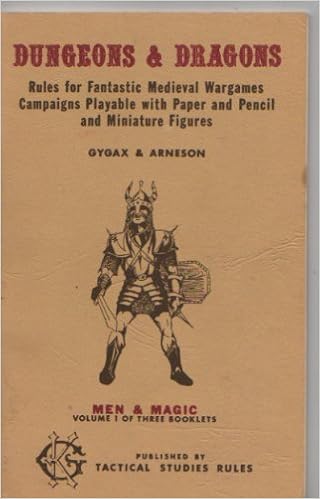
    • The Covers
      • Made of thick parchment paper, has lasted 30+ years and still solid.
      • Gary Gygax and Dave Arneson co-wrote the books.
      • There is a GK symbol on the bottom of the cover in fancy calligraphy next to the publisher's name, listed as TACTICAL STUDIES RULES I've got no idea what the GK symbol stands for. Curious...
    • Men & Magic Volume 1 of Three Booklets p1
      • The rules are based on CHAINMAIL Fantasy Rules, with special thanks to Midwest Military Simulation Association, the Lake Geneva Tactical Studies Association, Rob Kuntz and Tom Keogh (in memorium).
      • Illustrations are by Keenan Powell, Greg Bell, C. Corey, D. Arneson, T. Keogh, and David Sutherland
      • Copyright 1974 * Tactical Studies Rules
      • p2 - Index (Table of Contents)
      • p3 - Forward
        • Castle & Crusades Society created CHAINMAIL. (Sub-Note: Gygax founded the Castle & Crusades Society, and CHAINMAIL was one of his first products. For more detailed information read this Wikipedia Article).
        • Dave Arneson decided to created a medieval fantasy campaign for the Twin Cities Club, and used the map of "The Land" of "The Great Kingdom" which was the territory of the C&CS. Dave placed "Blackmoor" between "The Great Kingdom" and "the fearsome 'Egg of Coot' (an ego-maniacal mental monstrosity bent on the conquest of pretty much everything around itself) ". I suspect the Egg of Coot may have been a localized game-purposed version of Gharlane of Eddore. Just a hunch.
        • Quote: "While it is possible to play a single game, unrelated to any other game events past or future, it is the campaign for which these rules are designed." Sooooo! The rules are designed for Campaigns, not one shots. This is an interesting point, as I was under the impression from general readings previously, that in the very original D&D pretty much no one was expected to survive. The rules were simply too harsh to play as-is and expect to last more than a game or two. Clearly, however, this was not Gygax's intent, and so I will now regard those rumors as untrue.
        • You do not need miniature figures to play ("although their occasional employment is recommended for real spectacle when battles are fought"), and it will cost you almost nothing to set up a campaign. The most extensive requirement is TIME. Specifically the Referee's time (Sub-Note: the term Game Master or Dungeon Master has not been used yet).
        • He promises no shortage of Players "as there is unquestionably a fascination in this fantasy game". Players are not necessarily wargamers.
        • The longevity of Blackmoor (Twin Cities) and Grayhawk (Lake Geneva) are given as evidence, and the demand for the rules by other communities outside those areas, that suggests a bright future for D&D. How true that was!
        • The Rules are strictly Fantasy. Those wargammers who lack imagination and don't care for fantasy literature (numerous examples are given, including Conan, John Carter, etc) "will not be likely to find D&D to their taste" (Shocking). Those with imagination "will find the rules are the answer to their prayers".
        • Forward was written Nov 1, 1973 by Gary Gygax
      • p4 - Introduction
        • It is noted that the rules are "as complete as possible within the limitations imposed by the space of three booklets".
        • They cover the main aspects of fantasy campaigns but still remain flexible.
        • They are described as Miniatures Rules.
        • They are to be considered as Guidelines "to follow in designing your own fantastic-medieval campaign", and are intended to "provide a framework around which you will build a game of simplicity or tremendous complexity - your time and imagination are about the only limiting factors".
        • Fascination with the game will tend to make participants find more and more time for it.
        • Gygax and Arneson advise that a campaign be begun slowly, following the steps they outline in the booklets, "so as to avoid becoming too bogged down with unfamiliar details at first". I think there is good reason to build a campaign slowly for other reasons as well. For one thing, it allows the story to unfold and breath. I usually start my campaigns with the player characters at home doing chores, or some such, and then building up the adventure as news and stories of local events build up to the need for someone to rouse themselves up for an Adventure.
        • They recommend this so that the campaign will build naturally, and also recommend allowing the "laws" (rules, I assume) to be altered as the campaign makes progress in order to keep things continually new and provide for different situations to occur.
        • If you are a Player, the author approves and recommends you read the rules in order to gain "great advantage" during the game that might otherwise evade you. "A quick check of some rule or table may bring hidden treasure or save your game 'life'". Hence at the very beginning it seems Gygax encouraged (without so much as realizing it, perhaps) Rules Lawyering and Munchkinism. This in fact has to have been (I think) an outcome of the TSR business model - sell as many rules books as possible, which necessarily (and unnecessarily) spawned many evils. Naturally, Gygax wants to encourage Players to buy the rules as the expectation was that there would be 20 Players for each Referee, and TSR would rely on rules book sales to generate revenue for the company. Wouldn't you encourage Rules Lawyers, too? I'm sure we all would. Unfortunately. On the other hand things could have gone differently, but that's a topic for another blog post.
        • Men & Magic details what characters can be played, provides growth paths and limitations to them, and offers a selection of magic spells. Monsters & Treasures, it says, will describe beasts and creatures which can be encountered, as well as treasure amounts and so on. The Underworld & Wilderness Adventures book tells how to setup and actually play the campaign. He recommend reading the books in the order in which they are written.
Ok well that's as far as I'm planning to go with this today. I've read ahead several more pages and know what I want to outline, but as this is the first book I wanted to cover the Forward and Introduction in detail. Going forward I will focus on key points and provide my personal observations, critiques and corrections where I feel necessary. If you have any questions or comments, please feel free to ask or tell. I'm quite curious what others might conclude from these rules.

I would post photo images of the rules book pages, but I'm afraid I might run into some kind of copyright issues with WotC (or whomever owns the original D&D copyright at this point). If that is not the case, and there is no legal restriction, please let me know and I may go ahead and share images of selected pages. Thanks.

    Tuesday, October 13, 2015

    RPG Carnival: Something Has Come To Town


    It was one of those nights that's so pitch black you can not see your hand in front of your face. People are saying something came into town that night from the marshes and fens to the west. There's few folks who live out that way. No one saw it, but a few people talked about hearing a low pitched wailing sound in the wee hours of the morning the next day at Sullivan's Diner. I heard them whispering about it to the Sherrif, but he didn't seem to take their kind of talk too serious. They said it was a sound that had been haunting the fens and the pine forest for the past few months. It sounded like a peel of thunder raised up into the throat of a hound, or a wolf, and eventually dissipating into the night as a shuddering kind of laughter. It happened three times between two and four in the morning they said. They were awoken by it, and did not sleep again.

    Thirteen weeks later people had stopped talking about the tragedy ... That Mary Benson had been taken to the psychiatric hospital and would probably be there for some time. That their only son, Henry, a funny little boy of 9 who liked to play with toy soldiers and read super hero comics, was inexplicably withering away in his bed, unwilling to eat. That Mr. Benson had become grizzled, argumentative, violent and secretive. People stopped mentioning that Penny, their twelve year old daughter was still missing since the night of the dark wailing. No one wanted to think on it anymore. People started carrying weapons in town. Mr. Harrison accidentally shot a store window last week. He said he saw something in the fog.

    It was a full moon last night. Halloween will descend in another week, but none of us want to go out for trick-or-treat. It's been bitter cold lately. Huge murders of crows have been piling up on the trees west of town, darkening the grey sky at sundown, filling the shrouded days with their hellish cawing. Almost as if they were waiting for something. A feast of crows. Lately, one could imagine that. Two more families have fallen into ruins. The Galloway's house burned down the other night. No one survived. And then a block away, the Johnson's barn was broken into and four of the cows were ... slaughtered. In the barn. None of the Johnson's have been seen since that night. Their house is empty. The door was locked from the inside. Rumors of a black stain on the carpet in the master bedroom. But no sign of the Johnsons. Only a half eaten dinner was left on the dining room table, napkins strewn on the floor. Shoes. But no Johnsons.  And a barn with walls darkened by dried blood.

    It's been raining. The road leading from Fenhaven Village has been blocked by flooding for two days now. The shelves in the general store are bare, and Mr. Corning closed shop saying he needed to stay home with his wife. She came down with The Sickness last week, and she can't see and her fingernails turned black. The fog over the town is so think it's hard to see more than a yard past the hood of the car. But the fog is patchy. Sometimes it opens up and for 20 feet the air is crystal clear, almost like a bubble within the mist. Then it vanishes and we're enveloped in the chilly gray again. Once on the edge of the bubble, just beyond in the mist, I thought I saw something standing perfectly still. It was something that looked like it could have been a person, except that where it's head should have been there was something that seemed to drain the light. It's hard to explain. It looked, if I can describe it at all, like a hive of hornets converging on one black spot. I don't know. Maybe I didn't see it. Maybe it was my imagination. It vanished into the fog and we kept driving. My dad said I shouldn't talk about it. But I can't get it out of my head. Neither can he, I think.

    At dinner we heard something scraping at the window. None of us looked. No one spoke. We didn't eat. I looked at my plate. My hair was standing on end for two hours. Finally it stopped when the storm began and it was raining hard. I went up to bed. It's cold in the house tonight. I'm in bed writing. Lightning is playing tricks on the shadows outside my window. Shadows I don't like at all. I don't want to look at them anymore... but I can't stop myself. There's shadows... but there's no trees outside my window. Shadows of what?

    Monday, October 12, 2015

    Why Fantasy?

    A response to this post ... Why Fantasy at Advanced Gaming Theory Blog

    To go one step further ... we long to maintain our individuality in an age of conformity. Group-Think has left everyone trapped in a creativity neutralizing zone and we're sick of it. RPGs give us a chance to escape ... to enter the world of fantasy where we can be individuals - heroes ... if nowhere else than in our own minds. And one has to wonder ... how can we find meaning, creativity, individuality and heroism in the real world as well. I think we can learn a great deal from our RPG Fantasy experiences ... but we must apply those lessons, or they simply get lost in the miasma. I'm of the opinion that we are best off when we abandon the Group-Think, the mind-cage, and stretch our imaginations and soar on the wings of our inspiration ... as long as we don't simply stop there in the realm of fantasy ... but take the lessons learned there and carry forward and beyond into the world of reality. We need to make meaning in our lives. Fantasy has, in fact, always helped humanity to do that. RPGs are simply the latest and greatest form of the art.

    (Note: my reply comment on the original poster's blog got wiped out by some glitch or other, which was highly annoying. The only thing I could salvage from a much longer (and possibly more interesting) comment is what I have above. Sometimes the Internet is just plain infuriating. /rant)

    Thursday, October 08, 2015

    The Giant Cave Spider

    A creature from my menagerie ... This is a pretty low key monster without magic or special powers. It's effectiveness is in the gruesome size and frightful reality that such spiders in fact actually exist. I like to throw this kind of thing into my game often. I have magical creatures of course, but they are interspersed with nature's finest monsters in order to provide context and a bit of naturalistic flare to my world. It's more funnerer that way. :)

    The Giant Cave Spider

    The Cave Spider's habitat are holes in cave walls.  They can range in size from 2 to 24 inches, while Giant Cave Spiders can grow up to 72 inches. Their bodies are bumpy, ridged, broad and flat, with a segmented two-section abdomen. They have a pair of median eyes at the front of the carapace, and possessed three smaller eye pairs placed further back on each side, for a total of eight eyes.

    They tend to have poor eyesight. Their forelegs which serve in part as sensors, are spiked for grabbing and retaining prey, much like those of a mantis.  The first pair of very long and thin legs can extend several times the length of body, are whip-like, and have numerous sensory receptors. Typically, it will extend one of these legs out in front of it as it moves, and uses the other to probe the terrain to the side.  It will also use these long whip legs to probe for prey, and will even put them behind the pray to corral it into range of the gripping forelegs.  Once the prey is in range the Cave Spider snaps into action with blinding speed (+2 Initiative, +2 Armor Class for Hyper-Reflexes and Insect Plating). Once the pray is secured the Cave Spider will use it's long front fangs to suck the inner juices out while the victim is still living.

    Courting rituals involve the male depositing stalked sperm, which have one or more sperm masses at the tip, onto the ground, and using his probe legs to guide the female over them.  She gathers the sperm and lays fertilized eggs into a sac carried under her abdomen. When the young hatch, they climb up onto the mother's back.

    Cave Spiders will diet consists of insects, small rodents, and sometimes larger animals depending on the environment.  They do not typically hunt outside of the cave in which they live, but they may do so if food is scarce within the cave.  They can survive for two or three weeks without food.

    Elthos Stat Block
    Min Strength:   4 Max Strength:   6
    Min Wisdom:     2 Max Wisdom:     3
    Min Dexterity:  3 Max Dexterity:  6
    Max Level:      3
    Movement:       8 (fast)
    
    Cave Spider (Character Example)
    Race (Gender) Class..... Cave Spider (M) Freeman                 XP Base:  40
    Character Level (CL)....   3         Bonus    Movement:   8 ->   8
    Strength................   4 ........(+0)     Weapon             DMB ALM TAL
    Wisdom..................   2 ........(-1)     Fangs 1d6           +1  0   6
    Dexterity...............   5 ->   7  (+3)     Spiked Legs         -1  0   6 
    Mystic Attack Level (MAL)  2                  
    Mystic Armor Class (MAC)   2
    Life Points (LP)........  12                  Armor        ACM DXM DAB MOV TAC
    Mystic Points (MP) .....   6                  Body: Hyper*  +3  +2  +0  +0
    Current Experience......  80                  Body: Insec*  +2  +0  +2  +0
    Money................... 270                  Armor Total:  +5  +2  +2  +0  6
    

    Monday, October 05, 2015

    What Distinguishes Elthos RPG Mythos Machine?

    In response to a thread on Google+ with +Jeffrey Anthony ...

    It's fair assessment of the industry generally that it is saturated. The reason why, I believe, is the confluence of the idea that making a living via gaming would be wonderful, the _relative_ ease of entry into the gaming market through the development of an RPG Rules Book (no it is not easy, but it is far easier than creating a modern level computer game, certainly), and the availability of relatively easy online book publishing services. Hence, everyone and their brother wants to create an RPG rules system... well, obviously not everyone, but quite a number of people. And this has indeed lead to a flourishing profusion of Indie RPG rules books. I believe there are over 1500 different rules books on DriveThruRPG at this time. That's great and wonderful because it demonstrates the enthusiasm of the people in the hobby. What's not so great, as you have alluded, is that the result is a completely saturated RPG market. All of this is true.

    However, what is not so easy by comparison is to create a cohisive and comprehensive online web application that enjoins the rules system and makes GMing using that system far easier. There are some dabblings in that area, as we've seen from the phone app by DCC, and there are a profusion of minor tools that support various systems with excel sheets or generators of various sorts. And there are a handful of attempts at making GM Prep Tools, but those tend to be system neutral, or attempt to support as many of the popular RPG systems as they can program and get licencing for. Some of these tools have become quite sophisticated, and are gaining popularity. Fantasy Grounds comes to mind. City of Brass is a new entrant into the market. There is Realm Works by Lone Wolf. All of these fit into one or another of the categories I've described. All of them are interesting. Many of them are fondly utilized by GMs to help them run their games.

    What is quite rare, however, is an integrated system that focuses on one rules system that was designed from the beginning with a computer application in mind, in order to make the system easier to run, and a more integrated application... both of which go toward making GMing easier. Elthos RPG is a rules system that was designed to be integrated via the Mythos Machine web application. So it is a unified holistic system whose purpose is to make GMing better organized, faster and easier. I don't think the market is yet saturated with that combination. And I think this makes it, for the time being, unique.

    On the other hand, to be fair to your critique, it does require that people do learn yet another rules system. And I understand the barrier involved and why that is rather annoying for many. After all, we spend a lot of time as GMs learning rules systems, running games with them, and getting to fine tune our understanding of their nuances... why should I have to learn yet another one? But in the case of Elthos I would say two things. First, the rules are relatively light weight and easy to learn when compared with many other systems, and yet it maintains all of the standard tropes of the traditional RPG. Second, the rules are fully integrated with the Mythos Machine so that the entire package, once learned, does in fact make GMing easier.

    There are a few other advantages provided by the Mythos Machine to be considered. It lets you create any kind of World you want, being completely flexible and genre neutral. You can create any kinds of equipment, weapons and armor, skills and powers and classes you can imagine. In other words it gives you the freedom to create your own World. Yes, this is a chore. It is a chore in the same way that Legos is a chore. You get a box of bricks and ... you create stuff. With the Mythos Machine you get a web application that lets you create a proto-World and ... you create stuff. In the end, you have your own World that is far easier for you to run and maintain than what you had before.  Frankly, for me, that is far more exciting than having someone else's World to play with.  I have my own imagination and I like to use it.  Elthos RPG Mythos Machine was designed to support GMs who want to exercise their own Imaginations.

    Another advantage to the Mythos Machine is that it lets you share your creations with other GMs by making your things Public rather than Private. You have that choice for everything in your World, pretty much. What this also means is that if you are a GM who has a proto-World with not much in it yet, and you feel a little stuck maybe, you can go and browse what other GMs have created and quickly pull anything you like into your world with the click of a button, and then customize it to your needs. It's that simple.  I think this will help a lot of GMs get up and running more quickly, and giving people a way to share their creativity is a good thing.

    All of that said, I want to emphasize that the Mythos Machine is in Open Beta. While fully functional as is, it has yet to integrate in additional features which I want to see for it. But before I spend even more time on that, I want to get some feedback on the thing in its current state. So I'm encouraging people to go and take a look and provide feedback. Once I get an idea of what people like and don't like about it, I will be better positioned to work on filling in the gaps and adding more features. But as it is now, I use it to great effect as do some of my friends. It really has made GMing incredibly easy for me.

    How about one example... I am playing and the guys take a path down a road I had not really worked on much. I'd like to quickly drum up some Stuff for them to run into and I have a rough idea of what's down there. A goblin cave, lets say, with kobolds being run by an Ogre. I can use the mythos machine to instantly generate a group of kobolds, goblins and an ogre chieftain, fully equipped, with skills, ready to play - in about 1 minute.

    There are a lot of other examples I can give, but this post is getting tltr. So I will leave it there and hope this helps to answer your question.

    For those interested you can download the rules and try out the Mythos Machine at http://elthos.com ... we are looking for feedback so if you have any suggestions or recommendations or find anything amiss, please use the feedback button on the site (upper right hand corner).  Ok thanks!   Happy Gaming to you!

    Wednesday, September 23, 2015

    How I GM Elthos Social Encounters

    I wrote this in response to this Google+ Post... and thought it worthy to add to my blog...

    My strategy has always been to build encounters by determining who the main NPCs are, and what their personality and motives are. They are given a limited and finite amount of resources to work with and have personal objectives. It could be, for example, an NPC is Mutmaw, the Mayor of Hobbington whose objectives are to quell dissidents, enrich his friends and supporters, aggrandize himself to the Commons, and not step on the toes of those who are bigger than he is. His immediate objective is to find a husband for his big boned daughter Gurthtruda. He has a small number of personal henchmen who do dirty deeds, and he has a set of Officials under his command, including Drake Barnstormer the Captain of the Guard, Inspector Henderson the Detective (neither of whom are bad guys, actually), and so on. So, a typical adventure might include Barnstormer, and over the course of events may wind up drawing in the Mayor.  That remains to be seen based on what the Player Characters do.  I don't map out an exact path through any given adventure.  I simply set up the motives and objectives and personalities of those involved and then as the Role Play unfolds it reveals the story.

    When the Party gets to the point where they are not in combat and are simply in RP mode then everything is pretty much conversational. The Adventure is planned by defining what the adventure's objectives are, and who is who in relation to them. So in one case there was a murder mystery and Barnstormer was a key NPC, and Mayor Mutmaw showed up. Everything was done in Role Play. When the PCs asked specific questions I rolled I roll to see if the NPC knows the information at all, then again to see what the Reaction was (1 = least favorable, 6 = most favorable). If PCs ask smart questions and do not make trouble then they get whatever answers they can and the adventure moves on. Sometimes they are unlucky and they get an unfavorable reaction, and that can lead to other consequences, including, of course, combat.

    It goes on from there.

    Now that said, I do also include a few social skills in my world. Diplomacy for example. And people do use it on occasions where it makes sense. For example, if they are going to try to negotiate with Mayor Mutmaw. The person with the highest Diplomacy Skill Level will negotiate. There will be a Difficulty Level according to the nature of the request, and that DL will depend on the GM's arbitration, aka GM Fiat. They then roll to find out the Reaction, and if they win the roll, they win the negotiation. Like that. Those types of events are also Roll Played because I ask the Players to tell me exactly what they say. I then assign a DL based on the effectiveness of their statements. Sometimes they put a timeout on the game for a few minutes to discuss their rhetorical strategy, and if they come up with something that makes sense they get a bonus on the roll.

    That's how I deal with Social Encounters, mostly, and it's worked well for the past 30+ years. No complaints from the Players and it all runs pretty smoothly.